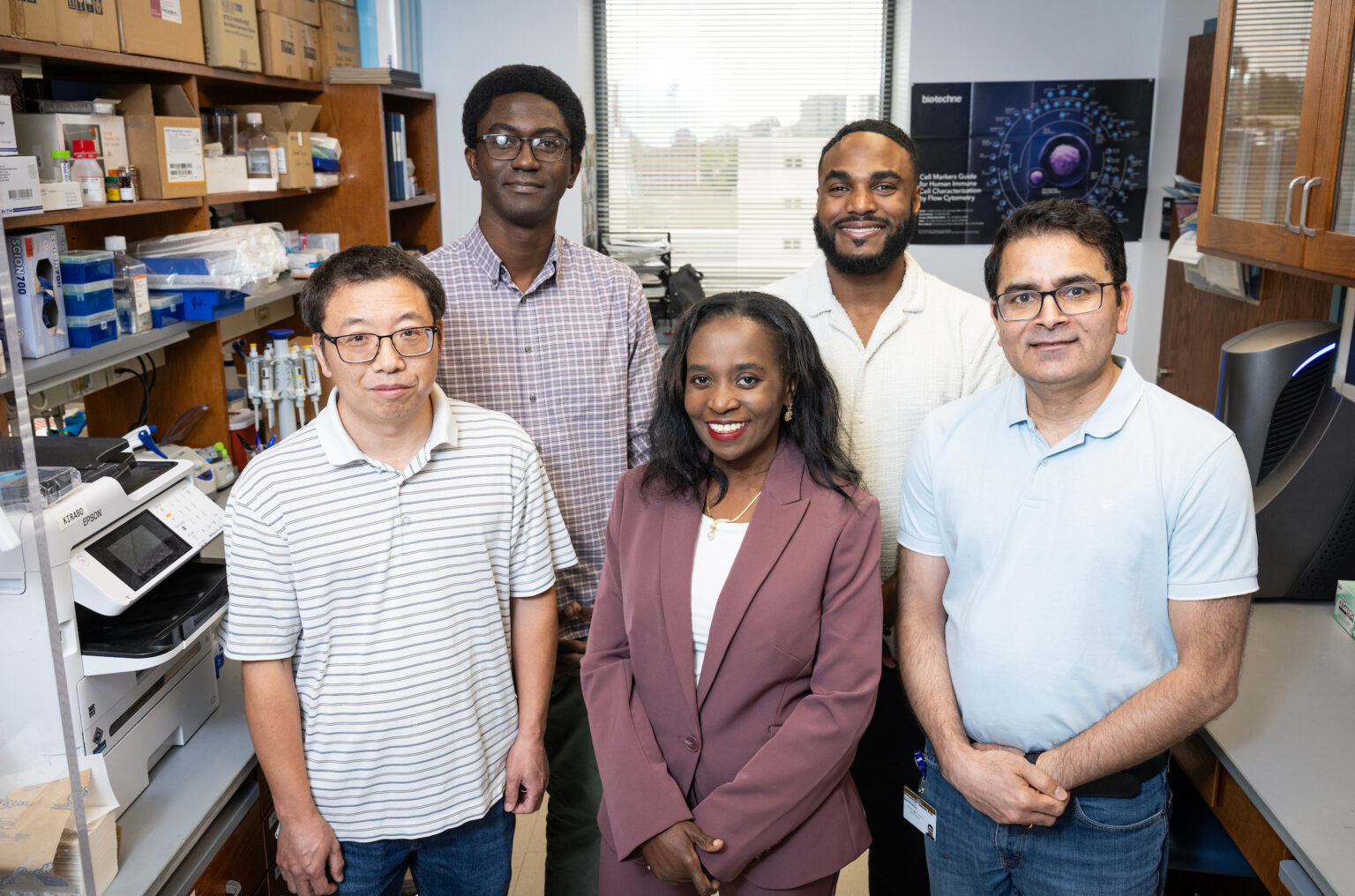
 Annet Kirabo, PhD, DVM, MSc, front center, and members of her research team, from left, Yinqiu Wang, MD, PhD; Jeremiah Afolabi, PhD, DVM; Claude Albritton, PhD candidate; and Mohammad Saleem, PhD, are exploring the molecular pathways that link dietary sodium to hypertension. (photo by Erin O. Smith)

For some people, eating a salty meal can be deadly.
Salt-sensitivity of blood pressure (SSBP) — an exaggerated increase in blood pressure after consuming salt — increases the risk of cardiovascular disease and death. It affects about half of all people with high blood pressure and one-quarter of those who do not have hypertension.
“Despite its well-established clinical burden, SSBP remains poorly understood,” said Annet Kirabo, PhD, DVM, MSc, Professor of Medicine in the Division of Genetic Medicine and Clinical Pharmacology at Vanderbilt Health. “The increase in blood pressure in response to salt can be significant enough to cause a heart attack, stroke and even sudden cardiac death, and yet it’s undiagnosed and goes untreated. It’s a silent killer.”
Kirabo and her colleagues have been exploring a novel role for immune cells in SSBP. They have now discovered that a signaling pathway called AP-1 complex links dietary sodium to immune-driven SSBP. The findings, reported in the journal Circulation Research, identify AP-1 as a potential therapeutic target for salt-sensitive hypertension.
The American Heart Association recommends less than 2,300 milligrams of dietary sodium per day (about one teaspoon of table salt), but fewer than 10% of the U.S. population meets this guideline; average consumption exceeds 3,100 milligrams of sodium daily.
“This excess dietary salt is particularly concerning for salt-sensitive individuals who have increased risk of cardiovascular disease and death, even in the absence of hypertension,” Kirabo said.
Kirabo and her colleagues previously discovered that sodium entry into immune cells promotes the production of reactive oxygen species, inflammation and SSBP. They hypothesized that high salt intake might activate the AP-1 complex, which is known to regulate inflammatory signaling.
In the current study, led by Taseer Ahmad, PharmD, PhD, a former postdoctoral fellow now on the faculty at the University of Sargodha in Punjab, Pakistan, the researchers used complementary studies in mouse models and human subjects to explore a role for AP-1 signaling in SSBP.
They assessed blood pressure responses and profiled immune cell phenotypes in a salt-sensitive mouse model. In a clinical study, they enrolled prehypertensive volunteers and performed an inpatient salt-loading/depletion protocol to characterize AP-1 gene expression signatures in salt-sensitive versus salt-resistant individuals. They also generated a mouse model with SSBP by transferring immune cells from salt-sensitive individuals and demonstrated that this SSBP was prevented by pretreatment with an inhibitor of AP-1 signaling.
Their findings show that:
- High salt exposure activates AP-1 signaling in mouse and human antigen-presenting immune cells.
- This immune activation contributes to changes in blood vessels and kidneys and can lead to higher blood pressure.
- Blocking this pathway can prevent some of the harmful effects of a high-salt diet on blood vessels and kidneys.
“Our findings identify AP-1 signaling as a potential new target for understanding and eventually treating salt-sensitive hypertension,” Kirabo said. “The findings are important given the increasing prevalence of high salt intake and the unmet need for precise interventions in hypertension.”
Ahmad is the first author, and Kirabo is the corresponding author of the Circulation Research study. Co-authors are Mohammad Saleem, PhD; Ashley Pitzer Mutchler, PhD; Lale Ertuglu, MD; Quanhu Sheng, PhD; Claude Albritton, Alexandria Porcia Haynes, Mert Demirci, MD; Selam Desta, Mohd Mabood Khan, PhD, MSc; Ronald McMillan, PhD; and Jeremiah Afolabi, PhD, DVM. The research was supported by the National Institutes of Health under grant R01HL144941.