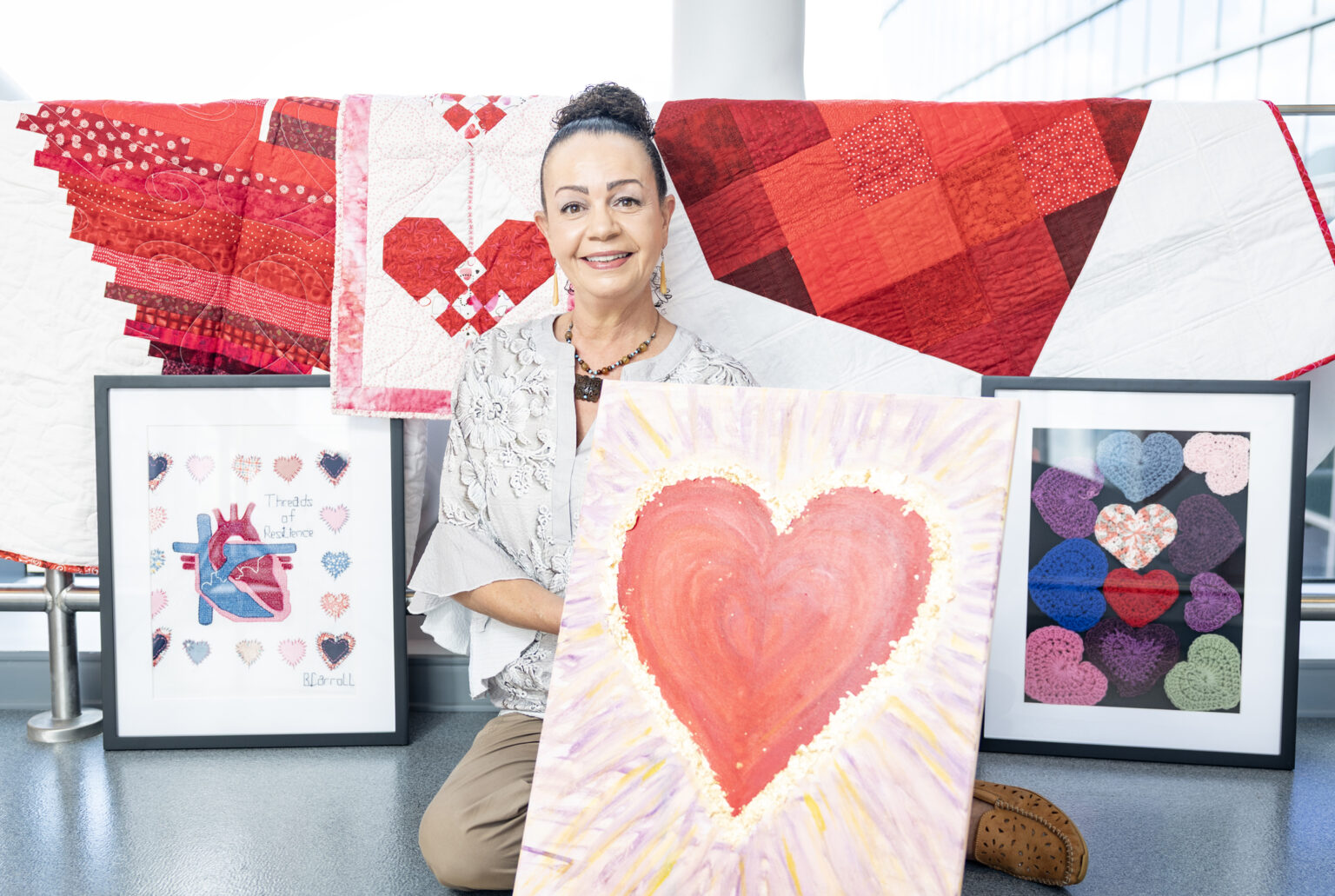
 Lauren Michelle Wells Fierro, LCSW, with several of the works created by patients with heart conditions. (photo by Erin O. Smith)

The best art comes from the heart. And, for two special groups of Vanderbilt Health patients, their heart condition journey involved making art — of their hearts.
It all started with social worker Lauren Michelle Wells Fierro, LCSW, who leads telehealth support groups for patients with heart conditions struggling with challenges such as depression, anxiety and post-traumatic stress disorder. Realizing she had several patients who enjoyed quilting, it sparked the idea to have patients create “heart art.”
“I thought, ‘I need to bring these ladies together,’” she said. “And then it just grew from quilting to all sorts of other creative measures: crochet, needlepoint, painting, writing.”
Starting with patients of the Vanderbilt Health Women’s Heart Center and another group for patients of the Adult Congenital Heart Disease Program, Wells Fierro created a virtual art circle of patients. Working remotely, the patients create art in their own homes in their spare time, share with the group virtually as it is created, then mail the art to her for display at the Vanderbilt Heart and Vascular Institute on the fifth floor of Medical Center East.
It’s therapeutic for patients, Wells Fierro said. Creating beauty is peaceful and takes their minds off their sometimes-complicated medical situations.
“It’s really about how creativity helps to heal the heart,” she said.
They are patients with a range of heart conditions. In the adult congenital group, patients have been dealing with some form of heart condition all their lives. In the Women’s Heart Center group, they may not have had known heart conditions until a heart attack brought them within an inch of their lives. But all are on a heart-related journey.
Patsy Crawford of the Joelton area of Nashville, who is in the Women’s Heart Center group, had no known heart condition until she had a serious heart attack in October 2024. The cardiac arrest was caused by a spontaneous coronary artery dissection (SCAD), when a tear forms in the wall of a heart artery, blocking blood flow. Unlike typical heart attacks from plaque buildup, SCAD heart attacks often affect young, healthy people with no heart disease risks, particularly women.
Crawford was at home, teaching her son in his homeschool program when it hit. “Do I need to call dad?” her son asked. “I was like, ‘I’m fine; don’t bother him. He’s at work. I’m gonna go lie down and take a nap.’ And so that’s what I did,” she said. “And I’ve since learned that’s what most women do when they never wake up again.”
Crawford ended up at Vanderbilt University Hospital, where she stayed for two weeks before returning home. By early 2025, she was part of Wells Fierro’s support group.
“She’s been really just a great … leader in all of this to coax us to talk about the issues that we’ve had through it all and our emotions,” Crawford said. “Talking with the other women who have had heart attacks and especially my type of heart attack, it’s helped me to not feel so alone.”
Crawford said she made quilts a couple of years before her heart attack but eventually stopped because of debilitating brain fog. She said her conversations with Wells Fierro and other women in the support group helped her realize the brain fog was the result of her medications. She talked to her doctor, who modified her medications, and the fog dissipated.
“I feel so much better,” she said. “My life is so much better now.”
In January, she created a quilt with a heart in its center. She said it helped her feel better, “because you have to really focus and concentrate, and it gives you something to focus on and not think about everything else that’s going on.”
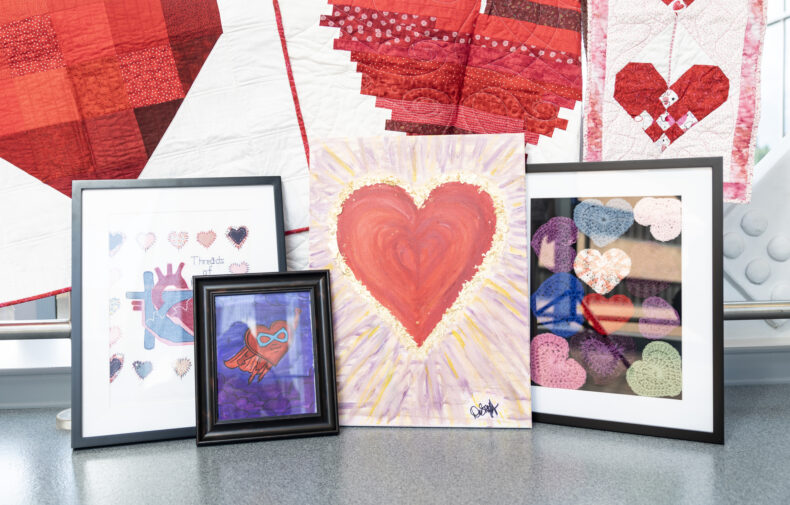
Brenda Carroll was born with congenital heart disease and had her first heart surgery when she was 7 years old, followed by three more as she grew up. She was referred to Vanderbilt Health by her cardiologist in Knoxville, Tennessee, and became part of the Adult Congenital Heart Disease Program and then Wells Fierro’s support group.
For her heart art, she cross-stitched a picture of the anatomy of the heart surrounded with “heart patches” representing repaired imperfections. She called it “Threads of Resilience.”
“To me, the heart symbolizes strength and resilience,” she said. “Strength, because it is a vital organ of every living creature and works endlessly to pump life into our bodies. Resilience, because although it isn’t always perfectly designed, surgeons can patch the imperfections, and the heart will persevere, giving maximum dedication for a lifetime.”
Carroll said having a lifelong chronic heart condition requires resilience to survive both physically and emotionally. The support group and heart art have helped her on her journey.
“Listening to others has helped me to be able to talk about my special heart,” she said. “I am so grateful for the opportunity to express how much this program means to me. It truly has been a positive and life-changing experience.”
Wells Fierro said the heart art program has enriched her therapy.
“It is truly an honor to get to serve these patients,” she said.
Kathryn Lindley, MD, director of the Vanderbilt Health Women’s Heart Center and holder of the Samuel S. Riven, MD, Directorship in Cardiology, said, “We are so fortunate to have Lauren as a part of our team. She is an essential part of the healing journey for our patients — helping heal the whole person.”