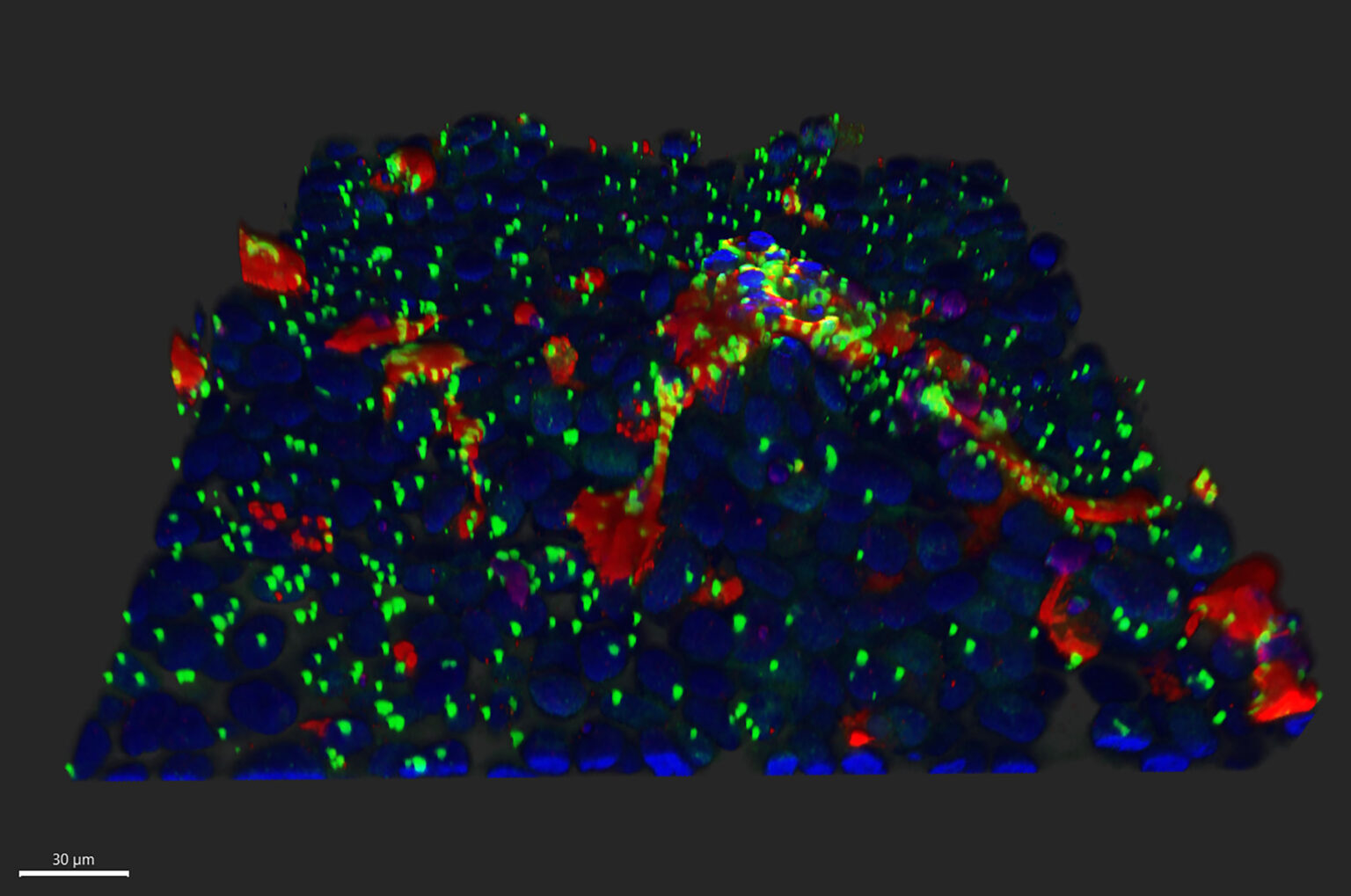
 The bacterium Bacteroides thetaiotaomicron (green) adheres to mucin-2 (red), which coats epithelial cells (blue), the protective cells that line the intestines. (image courtesy of Nahyung Ko; Alexander Westermann Laboratory)

An international research team has uncovered mechanisms for how one of the gut’s “friendly” microbes adapts to different environments within the gastrointestinal tract.
The findings, reported Nov. 25 in Nature Communications, are important for informing future strategies aimed at manipulating the gut microbiome to promote beneficial microbial functions, said Wenhan Zhu, PhD, Assistant Professor of Pathology, Microbiology and Immunology at Vanderbilt Health and co-corresponding author of the paper.
Helpful gut microbes aid digestion, help train the host immune system, and resist the colonization of intestinal pathogens. But the gut is not a uniform environment, and microbes must adapt to different nutrients, oxygen levels and host defenses depending on where they are — for example close to the intestinal surface versus farther out in the gut lumen.
“Where a bacterium lives can change what it ‘eats,’ how it interacts with the host, and how well it survives,” Zhu said. “Understanding how beneficial gut bacteria adapt to different gut environments is important if we want to ultimately understand what makes a microbiome stable and healthy — and why that stability breaks down during disease.”
To explore how bacteria colonize different gut “niches,” Zhu’s team collaborated with the group of Alexander Westermann, PhD, Professor of Microbiology at the Julius-Maximilians-Universität Würzburg (JMU) and an affiliated scientist at the Helmholtz Institute for RNA-based Infection Research (HIRI) in Würzburg, Germany.
The investigators established a novel in vitro co-culture model of mucus-producing human gut epithelial cells and the bacterium Bacteroides thetaiotaomicron — a well-studied member of the human gut microbiota that can occupy varied environments, including the intestinal lumen and the mucus-associated layer close to the epithelium.
“A major strength of the study was that we could follow both the bacterium and the human epithelial cells at the same time and over time,” Zhu said. “Alexander Westermann’s group has extensive expertise in bacterial RNA biology and dual RNA sequencing, and together our teams combined these approaches with bacterial genetics, biochemical measurements and mouse colonization studies.”
The researchers confirmed that B. thetaiotaomicron bacteria living close to the mucus layer experience a very different environment from bacteria further away, with the mucus-associated population showing evidence of iron limitation and increased expression of pathways involved in using host-derived carbohydrates as nutrients.
They identified a previously uncharacterized small regulatory RNA that responds to iron limitation, which they named IroR, and demonstrated that IroR helps coordinate several aspects of bacterial adaptation. But they were surprised to discover that IroR wasn’t always beneficial. It improved bacterial fitness when iron levels were limited in vitro, but its effect on colonization in the mouse gut was more complicated: Bacteria without IroR had a competitive advantage over bacteria with the small RNA.
“To me, that is one of the most interesting biological lessons from the study,” Zhu said. “A regulatory system does not necessarily exist to maximize fitness in one specific environment. The gut is constantly changing, and bacteria may need regulatory programs that allow them to balance competing demands — such as acquiring enough iron, using available nutrients and maintaining the right cell-surface properties — across many different environments.
“Understanding the microbiome requires more than knowing which bacteria are present. We also need to understand where they are located and what physiological state they are in.”
In future studies, the researchers will explore precisely how IroR senses environmental conditions and the full set of genes it regulates. They also plan to move from studying individual bacteria like B. thetaiotaomicron to studying microbial communities since the environment is shaped not only by the host but also by other microbes.
“Ultimately, our goal is to understand the rules that determine microbial fitness in the gut well enough that we can predict — and eventually manipulate — how microbiomes respond to changes in diet, inflammation and disease,” Zhu said.
Thomas Guest, PhD, and Gianluca Prezza, PhD, from JMU and HIRI, and Ryan Fansler, PhD, from Vanderbilt Health, are co-first authors of the Nature Communications paper. Westermann and Zhu are co-corresponding authors, and other authors are Gohar Mädler and Hannah Schlauch from JMU and HIRI.
The research was supported by the European Research Council, German Research Foundation, SFB1583 DECIDE, Cluster for Nucleic Acid Sciences and Technologies – NUCLEATE, U.S. National Institutes of Health (grants F31AI178950, R35GM147470 and R01DK134692), Colorectal Cancer Alliance, Pew Charitable Trust, and The G. Harold and Leila Y. Mathers Charitable Foundation.