



 Illustration by Diana Duren
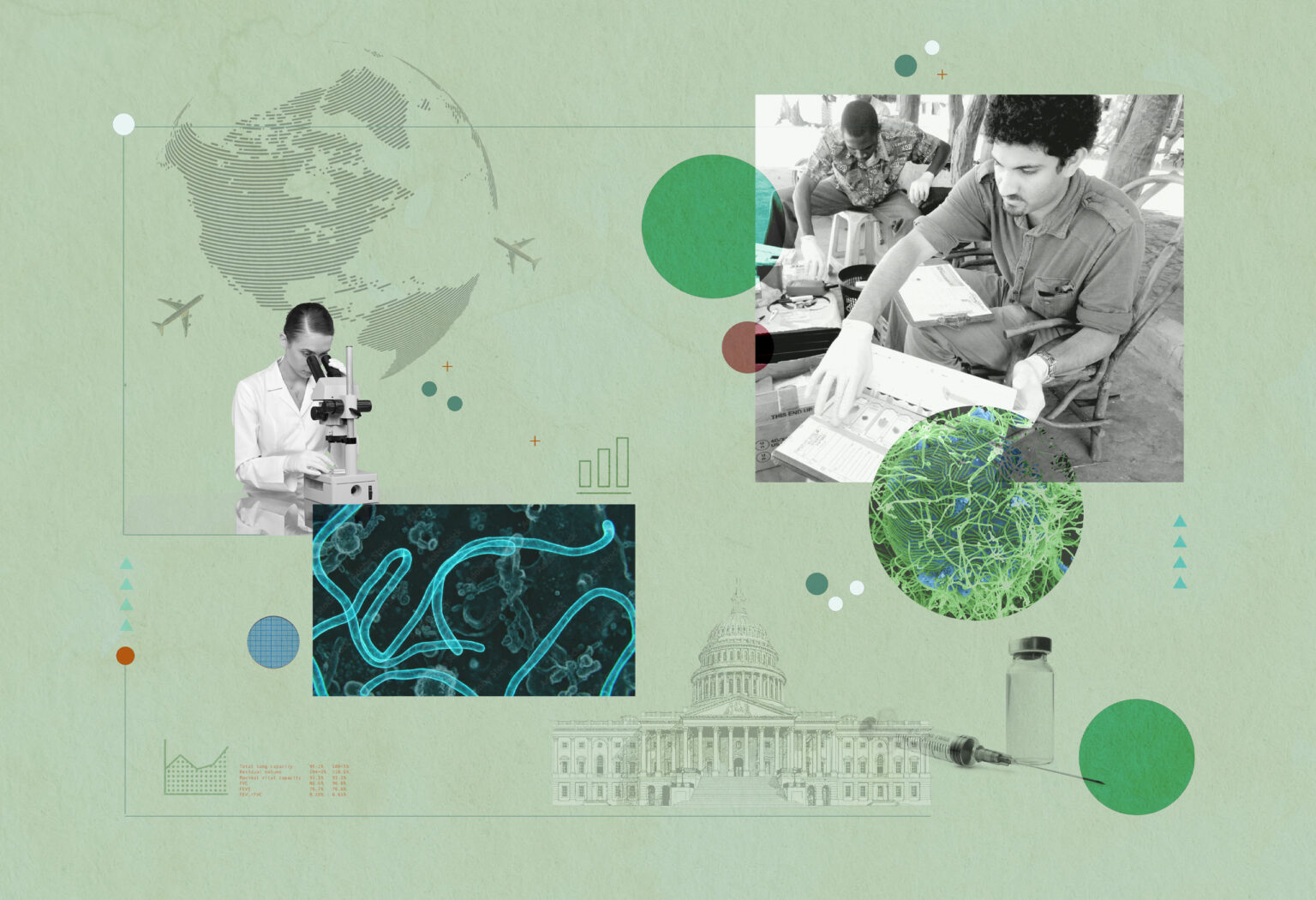
An epidemiology and health policy expert with the U.S. Homeland Security Council fields a call from the White House to formalize next steps in the federal response to the Ebola outbreak, now the largest in the Democratic Republic of Congo’s history.
A New York City Department of Health and Mental Hygiene informatics specialist leads a team to develop and deploy Public Health Partners Connect, a data project that allows the department to identify and manage relationships with more than 20,000 external partners. This system supports NYC Vaccine Finder, launched during the COVID-19 pandemic. The online tool is now part of a comprehensive public health mapping tool, connecting 8.58 million residents with resources throughout the city.
A Tennessee Department of Health leader is the principal investigator for the Rural Health Transformation Program, overseeing the awarding and distribution of $1 billion in federal grants to local initiatives to strengthen the state’s rural health care infrastructure.
A Vanderbilt Health pediatric infectious disease specialist directs global infection surveillance and prevention research, leads vaccine trials, and serves as a principal investigator for the Centers for Disease Control and Prevention-funded New Vaccine Surveillance Network. The network assesses pediatric viral respiratory and gastrointestinal infections and vaccine impact in children.
These are just a handful of myriad examples of how graduates of the Master of Public Health program at Vanderbilt University School of Medicine are shaping and impacting public health, conducting lifesaving investigations, implementing vital quality improvements, and guiding health care transformations to build healthier communities worldwide.
The MPH degree is one of nine professional degrees conferred by Vanderbilt University School of Medicine. It is also supported by the Vanderbilt Institute for Population and Public Health (formerly the Institute for Medicine and Public Health).
The two-year, interdisciplinary program, initially affiliated with the Department of Preventive Medicine, enrolled its first students 30 years ago in 1996. As of 2026, there have been more than 400 graduates. For the first 15 years, the program focused on preparing physicians and others with doctoral degrees for research and practice careers in academia and applied public health.
Then in 2010, concentrations in global health and epidemiology were established, and admission requirements were updated. The global health track admitted its first students in 2012.
“When we opened the global health track, we attracted a much broader group of students,” said Christianne Roumie, MD, MPH, Professor of Medicine, Pediatrics and Health Policy, and Director of the Master of Public Health Program. “At the same time, we continued to focus on retaining our small, career-focused program where we give students individualized mentorship and leadership skills to create the new kind of public health professional that we envision going out into the world and representing the Vanderbilt way of doing things. This is a small but mighty program.”
In 2011 the Department of Preventive Medicine was renamed and its scope expanded. The new Department of Health Policy, led by founding Chair Melinda Buntin, PhD, became a base for health policy research and built on existing programs in population-based epidemiology and prevention. Continued recruitment of world-class experts has resulted in a strong primary faculty core of around 20, supported by secondary, adjunct and affiliated faculty. An MPH program track focused on health policy was subsequently added in 2016.
“Just as Vanderbilt Health has a clear focus on personalized medicine, we do personalized MPH.”
Russell Rothman, MD, MPP
An intentional 2-to-1 student to faculty ratio, with an average annual MPH class size of 30, means the students in the MPH program develop close mentors and relationships with colleagues, said Roumie, who graduated from the program herself in 2005. That personalized approach is one that works well, she added.
“Just as Vanderbilt Health has a clear focus on personalized medicine, we do personalized MPH,” said Russell Rothman, MD, MPP, Director of the Institute for Population and Public Health and Senior Vice President for Population and Public Health. “Some students are physicians in fellowship training, and they’re getting this MPH to advance and build a career focused on research or the more clinical aspects of public health or population health. Some students are fresh out of undergrad; this is their final degree, and they want to go into the workforce. This is about building that pathway for each student to make sure that they have all the essentials for success — critical thinking, basic epidemiology, evaluation, public health, leadership skills and confidence.”
Pivoting from winemaking to health informatics
Senior Director of Strategic Analytic and Informatics Initiatives
Jay Bala, MPH’14, DrPH, was working as a chemist for one of the world’s largest wineries in California, when he realized he wanted to do something more. He knew people would still be drinking great wine, whether he was at the bench analyzing the vintage or not. Bala had a particular interest in global health, which drew him to apply for the global health track of the Vanderbilt MPH program. The program’s smaller size and welcoming atmosphere were added bonuses.
“Wine was great, and I really enjoyed it, but at the end of the day, it didn’t fulfill that itch of wanting to help and improve the world,” Bala said.
For his public health practicum at Vanderbilt, Bala traveled to rural Zambia, where he tracked data on malaria and helped manage epidemiological surveillance for rural clinics. The experience solidified his love of informatics.
Today, he is the Senior Director of Strategic Analytic and Informatics Initiatives at the New York City Department of Health and Mental Hygiene, where he leads a team of data scientists, data engineers, analysts and public health professionals to develop data projects and infrastructure for the agency to be more efficient or agile when it comes to meeting the needs of the city’s population. He maintains many connections he formed during his time at Vanderbilt.
“It’s really nice to develop those relationships as you’re learning about public health, and then later on, use them as a sounding board or a safe space when you have an idea around a project you’d like to launch,” he said.
Reimagining immunity and infection control
Professor of Pediatrics, Monroe Carell Jr. Children’s Hospital at Vanderbilt
Natasha Halasa, MD, MPH’04, Craig-Weaver Professor of Pediatrics in the Division of Pediatric Infectious Diseases at Monroe Carell Jr. Children’s Hospital at Vanderbilt, remembers discussing her career path with her pediatric residency mentors at Columbus Children’s Hospital. She was interested in clinical research, and they advised her that to “really do clinical research well,” she needed additional, formal training.
That made Halasa’s next steps easy. She came to Vanderbilt to complete a fellowship in pediatric infectious diseases, guided by her mentor Kathryn Edwards, MD, Professor Emerita of Pediatrics, an internationally recognized expert in vaccinology. And she concurrently completed an MPH.
“The MPH was 100% instrumental in me having a better understanding of clinical research and how to think critically,” Halasa said. “I learned how to review articles — to look at them critically to make sure the research is done properly. Do the results line up with their methods, and do their conclusions align with their results? And how to do my own clinical research and do it well.”
And it’s paid off. Since 2002, Halasa has been involved in pediatric vaccine trials, including infants and specialized populations, including immunocompromised hosts. She directs the Vanderbilt Infection Surveillance and Prevention Research Program, determining the burden of diarrheal and respiratory illnesses in children and specialized populations and finding ways to reduce their burden.
She is currently principal investigator of three National Institutes of Health grants investigating high-dose influenza vaccine versus standard-dose influenza vaccine in pediatric and adult solid organ recipients. She is the site PI for the CDC-funded New Vaccine Surveillance Network, and contact PI for the NIH-funded ECHO (Environmental Influences on Child Health Outcomes) biorepository.
“I always say that having an MPH sends the message that you think public health is important and that you received formal training for clinical research,” she said. “There is definitely credibility that goes along with it.”
Defending populations on a global scale
Rachel Idowu, MD, MPH’14, is a Director for Bioresponse for the Homeland Security Council within the Executive Office of the President. Her current assignment addresses the Ebola outbreak in the Democratic Republic of the Congo (DRC). She offers her expertise in guiding how federal funds are spent on outbreak response to reach the end of the crisis as quickly as possible.
“These outbreaks — whether it’s Ebola in the DRC or the cyclosporiasis outbreak happening in the United States with lettuce, the question is” Idowu asked, “how do human beings come into contact with pathogens in nature? And what are the health systems that can put boundaries on how far and how quickly an outbreak spreads?
“There are parts of the world where one or two cases happen, and the system is strong enough and responsive enough to identify it quickly, notify the right authorities, and put the tools in place to stop it. We’re grateful when a system works like that, but … sometimes the pace of how an outbreak spreads outstrips the government’s ability to manage.”
The United States is protecting its borders by directing federal resources to save lives and contain the virus.
“President Trump is serious about not wanting Ebola to come to the United States and is putting a lot of resources — financial as well as technical — into solutions inside the DRC so it can be controlled there,” she said.
Idowu initially came to Vanderbilt for a general surgery residency, and never imagined a government career in Washington. She had nudges from wise mentors early in her medical training who told her public health was the best fit for her big-picture mindset.
“They said, ‘Surgery is great, but if you really want to change lives at national and international scale, you’re going to need to do public policy or public health or something that gives you that 30,000-foot view over how health systems work’ … They were right.”
After earning her MPH, Idowu joined the Centers for Disease Control and Prevention, and from 2012 until 2024, she helped more than 20 countries with limited resources organize and restructure their public health systems.
Strengthening the neighborhoods he knows
Deputy Commissioner for Public Health Infrastructure, Tennessee Department of Health
JW Randolph, MPH’18, grew up in rural East Tennessee, near the confluence of the Hiwassee and Tennessee rivers. His first job out of college was serving as an environmental and community advocate in Washington for Appalachian Voices, a nonprofit organization formed to protect the natural resources and people of Appalachia.
When his wife matched at Vanderbilt for her pediatric residency, they returned to Tennessee. For a few years, Randolph did similar public policy work at the Tennessee General Assembly before enrolling in the Vanderbilt MPH program.
“I backed into public health from doing public policy work,” Randolph said. “I came to the MPH program to really learn more about how we can better use systems and ensure conditions that allow communities to thrive.
“Vanderbilt taught me to value data, but also the importance of relationships, communication and the lived experience of the communities we serve. Those principles still guide my work to strengthen Tennessee’s rural health system, support older adults and caregivers, develop public health leaders, and build a culture within the Department of Health that’s grounded in trust, compassion, service and excellence, which are our four values.”
In 2018, Randolph joined the Tennessee Department of Health as a policy analyst. In 2024, he was named Deputy Commissioner for Health Strategy and Regulation and now serves as Deputy Commissioner for Public Health Infrastructure.
One of Randolph’s key roles is overseeing the Tennessee Healthcare Resiliency Program, an initiative funding capital investments and practice transformations for rural and underserved communities. Backed by federal recovery and Rural Health Transformation funds, it aims to expand care capacity and modernize medical infrastructure statewide.
“My public health mission that I established as a student is ‘first-world health outcomes for all people in my home state of Tennessee,’” Randolph said. “A billion dollars is not nearly enough to get us there, but we know that we have an opportunity to do good things with these public resources, and I’m grateful to the people that I built relationships with there, who I learned from and who continue to play a supportive role in helping the state of Tennessee do good things for our people.”
Staying ahead of the curve – The prevention paradox
The world’s public health landscape has shifted seismically over the past decade. The “prevention paradox” notes that it’s only when things go wrong that you notice public health. Lessons learned from COVID-19 have fueled collaborations among local, regional, national and global stakeholders to improve public health outcomes and improve preparedness for the next pandemic. Environmental changes have spurred important initiatives to safeguard and sustain global health. Big data and new ways of using artificial intelligence have the potential to make disease prevention and tracking more effective and efficient. At the same time, funding has become increasingly uncertain for research, training and new population health initiatives.
A big impact on training the next generation of public health leaders has been the Department of Education’s reclassification of many health care and public service degrees, including the MPH, which no longer qualify as “professional degrees” under federal student aid rules. This change, effective July 1, lowers the amount of loans for these programs, which can create financial barriers for students.
Leaders in public health education are adjusting course to stay ahead of the curve. Vanderbilt is part of the Association of Schools and Programs of Public Health, and the group’s monthly check-ins and annual retreat are opportunities for stakeholders to strategize so the contingent of well-trained public health professionals remains robust.
“We’re definitely doing a lot of self-reflection about what is the future for MPH degrees here and across the nation,” said Rothman, who is also the Ingram Professor of Integrative and Population Health. “We are sticking to our ‘North Star’ of training students so that they understand the ways they can improve health for individuals, for families, for communities and for the public more broadly. At the same time, we are thinking about how to make our public health messages more aligned with the public. How do we partner with communities to help people understand the importance of public health?”
“We’re exploring partnerships to help provide continuing education for the Tennessee Department of Health … they are really looking for knowledge to expand their skill set.”
Christianne Roumie, MD, MPH
Securing funding for dedicated, endowed scholarships to attract a wider pool of MPH applicants and to support students throughout their training is a significant goal, Roumie said. Also, in addition to the traditional two-year MPH program, the idea of an accelerated pathway degree is being considered, as well as providing continuing education opportunities for public health professionals.
“We’re exploring partnerships to help provide continuing education for the Tennessee Department of Health,” Roumie said. “Many employees at both the state and the county health departments might not have a master’s in public health; they might have a bachelor’s degree in public health or another degree. They are really looking for knowledge to expand their skill set. So, we’re partnering with them to provide training seminars, both some clinical training for those front-line county health professionals and public health content that addresses methodology and other helpful topics.”
Roumie and Rothman agree that while there are many uncertainties as new health professionals are trained to tackle public health issues, the payoff of doing it right is well worth it. A significant way others can help is to support scholarships for MPH students.
“Some of this has been very challenging, but we’re using this as an opportunity to improve and expand ways that we train people for future public health roles, because when public health works well, it helps everybody,” Rothman said.