Parkinson’s disease Archive — Page 3 of 3

Dried fava beans in a small green ceramic bowl on a white background.
April 29, 2013

Fava beans’ impact on urine sodium

Eating fava beans increases dopamine in blood and urine, but does not stimulate urinary sodium excretion.

March 21, 2013

Novel push-pull action clue to brain disorders

Researchers at Vanderbilt University have discovered a new “push-pull” mechanism in the brain that one day could lead to new treatments for movement disorders such as Parkinson’s disease, as well as stress-related disorders and addiction.

Scientific illustration of a magenta G protein-coupled receptor embedded in a gray cell membrane, attached to blue, green, and gold G-protein subunits. Green and red molecular models with arrows indicate exchange of GTP for GDP.
October 18, 2012

Nobel in Chemistry reveals VU ties that bind

Several Vanderbilt researchers have collaborated with this year’s Nobel Chemistry winners.

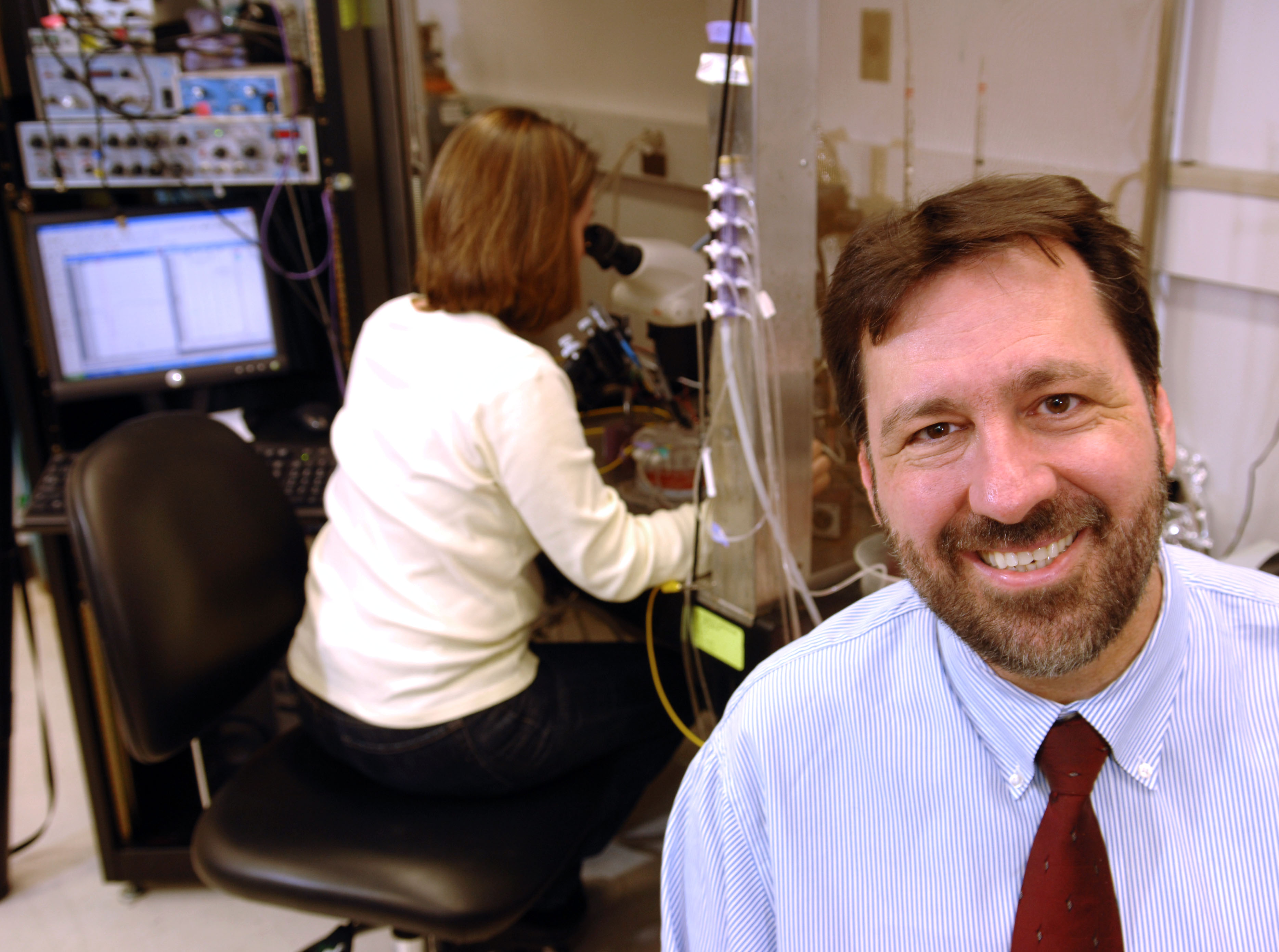
A bearded man in a striped shirt and red tie smiles in a research laboratory while a woman in a white lab coat works at a microscope and computer behind him.
September 21, 2012

VU, Bristol-Myers to collaborate on Parkinson’s therapies

Vanderbilt University and Bristol-Myers Squibb have signed a collaboration agreement for the discovery, development and commercialization of novel therapies acting on the mGluR4 glutamate receptor, known as positive allosteric modulators, or PAMs, for the treatment of Parkinson’s disease.

Profile silhouette of a human head filled with overlapping colorful three-dimensional letters.
September 7, 2012

Parkinson’s therapy may impact language

Deep brain stimulation used to treat Parkinson’s disease may impair some aspects of language processing, a recent study suggests.

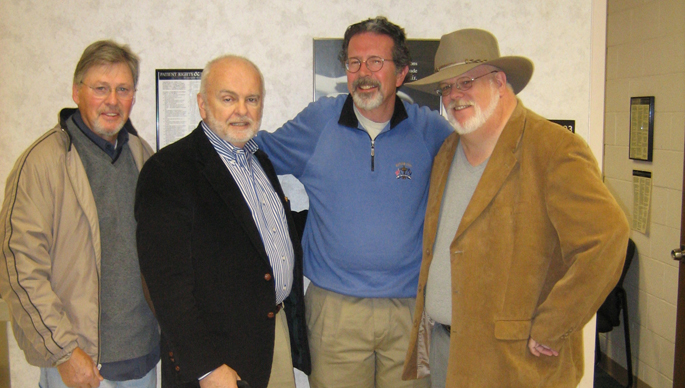
Four men stand together indoors, with their arms around one another. From left, Wayne Holt, Dale Nevels, Duane Cook and Bill Schmalfeldt, according to the caption.
August 23, 2012

Events honor early patients of novel Parkinson’s study

Pioneers of Parkinson’s disease research are gathering at Vanderbilt University Medical Center today to celebrate the end of a study that was an important first step in the quest to find a way to slow the progression of the degenerative movement disorder.