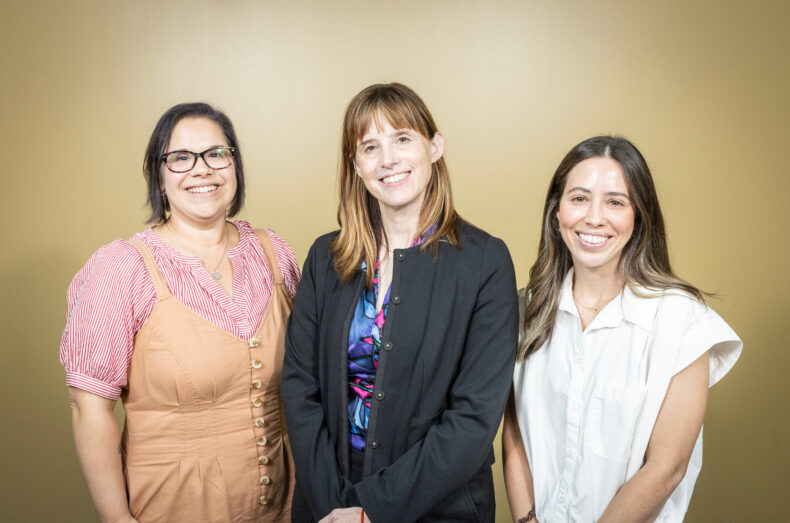
 The Vanderbilt Health Firefly group, photographed at Vanderbilt Health One Hundred Oaks on Aug. 6. (photo by Erin O. Smith)

Firefly, Vanderbilt Health’s clinical care and support program for pregnant and postpartum women with substance use disorder, was named to convey a lighted path for mothers in recovery and their infants. That path has expanded to Vanderbilt Wilson County Hospital and beyond.
The program started in 2011 as a prenatal clinic to address opioid dependency in pregnancy. In 2020, a large Center for Medicare and Medicaid Innovation grant opened opportunities to expand to the current interdisciplinary program that includes collaborations between pediatrics and behavioral health, and services like an intensive outpatient program, parenting classes, collaborative mental health care, peer recovery coaching and more.
In May 2025, the program expanded beyond its primary location at Vanderbilt Health One Hundred Oaks to VWCH.
“Firefly serves all of Middle Tennessee, including 26 counties,” said Firefly Medical Director Jessica Young, MD, MPH. “In reviewing our demographic data, we noticed that Wilson County was the second highest in terms of where our patients live, so it made sense to bring more services there.”
According to Young, Firefly has served 27 pregnant patients at VWCH, with the goal of serving 50-100 patients annually, working closely with the Vanderbilt Center for Women’s Health Lebanon team and partnering with local recovery clinics. The program has also connected with local charities to be able to refer patients for any health-related social needs.
“When we started expanding Firefly’s reach, it wasn’t just about growing the program — it was about making sure no patient got left behind,” said Reesha Sanghani, MD, MPH, Associate Professor of Clinical Obstetrics and Gynecology. “Getting to reach individuals that previously couldn’t be a part of the program and benefit from our services has been extremely inspiring and fulfilling.”
One of the biggest barriers for pregnant women to get treatment for substance use disorder and prenatal care is stigma.
“We are the only practice in Wilson County that I am aware of that integrates prenatal care with substance use disorder treatment,” said Young, Associate Professor of Clinical Obstetrics and Gynecology. “We also want to be a support for women who are getting their addiction treatment at other local practices. They can continue their medications for opioid use disorder with their current provider while knowing they will be getting prenatal care in a place that supports them without judgment.”
In addition to VWCH, Firefly also offers services at Vanderbilt Health obstetric clinics in Pleasant View, Columbia and Lawrenceburg. This expansion to regional clinics has been made possible by grant funding from Tennessee’s Opioid Abatement Council.
“Firefly expansion has proven to be successful in many ways; for example, we are able to reach communities that would otherwise not be attainable to receive our services,” said Kiva Crutcher, a certified peer recovery specialist in Lebanon. “I personally get to witness the transformation from addiction to recovery in the lives of prenatal and postnatal women who have struggled with opioid use disorder, substance use disorder and alcohol use disorder.”
Every patient gets an individualized treatment plan and is linked with a certified peer recovery specialist and social worker to complete a psychosocial assessment. They have the option of enrolling in a contingency management program where they earn points and rewards for everything they do that promotes their recovery and a healthy pregnancy.
A lactation nurse meets with patients prenatally and supports them after birth with breastfeeding. Postpartum, the program strives to keep people engaged for two years while getting them linked with community support and other medical needs.
“From our quality improvement data, we see that moms (and their babies) enrolled in our program do better,” Young said. “Most of our moms breastfeed, and only 13% require medication treatment for withdrawal, which is much lower than the state average. The majority of Firefly babies (91%) get discharged home to their biological mom, which is an indicator of how well they are doing in their recovery.”