


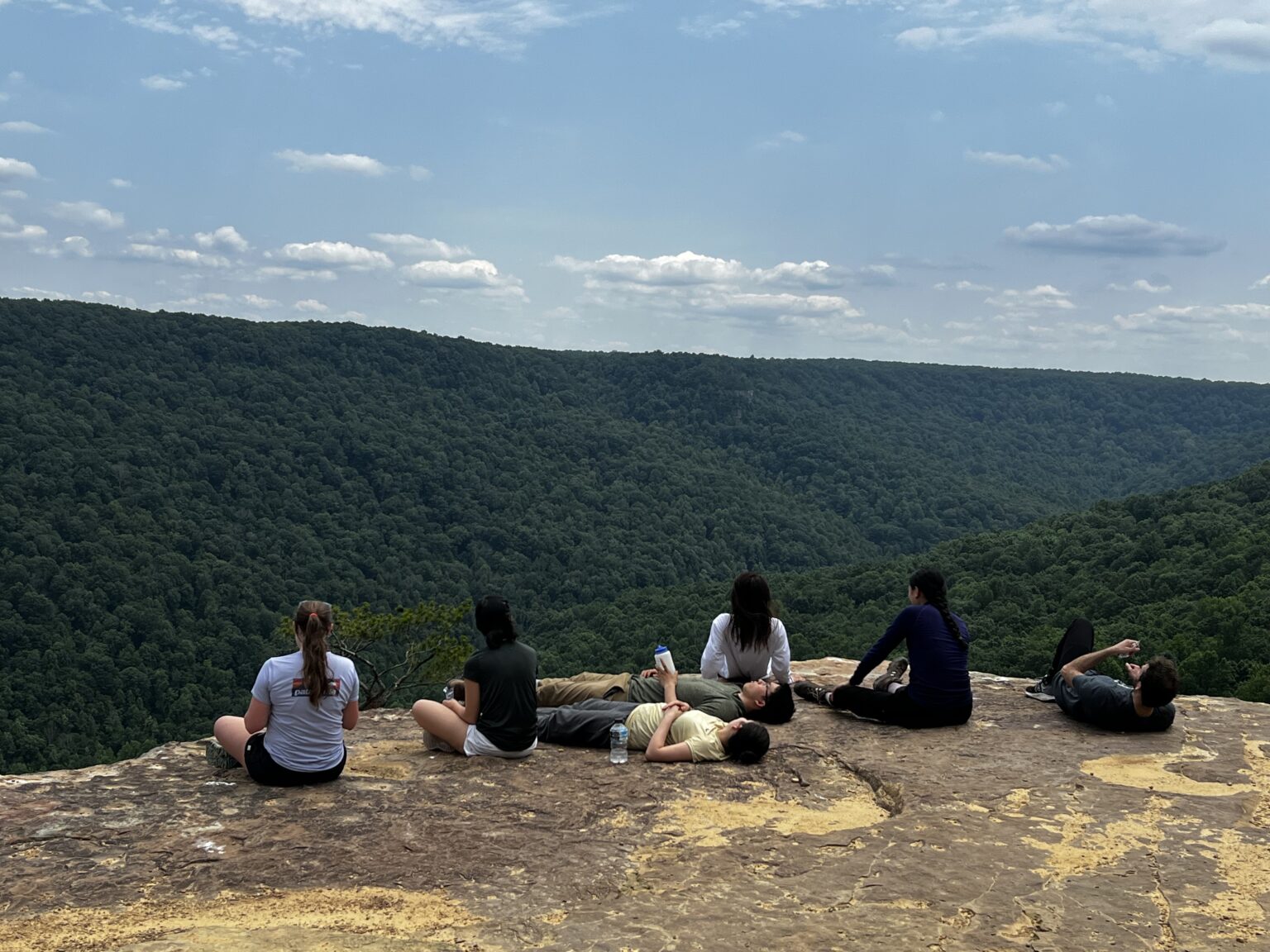
 During a day of hiking, medical students taking the wilderness medicine elective at Vanderbilt University School of Medicine admire a view of Middle Tennessee’s rolling highlands. (submitted photo)

After a day spent enjoying a geothermal hot spring in the Utah wilderness, Gauri Garg and her friends were navigating an icy trail back to their car when they encountered a man who had slipped and broken his leg.
Lack of cellular reception meant they were his best bet for reaching medical help. They splinted his leg and cobbled together a gurney from branches, shoelaces and an extra pair of pants. He was a large man, so it had to be sturdy. They began a slow, mile-long hike out.
“One of my friends had taken a wilderness medicine course, so they had a good idea of what to do,” she said. “We had around 10 people carrying him. Others were putting their jackets down on the trail so we wouldn’t fall on the ice.
“It was after sunset, and we were in swimsuits and jackets. We were so cold. Finally, EMTs came, and they had a board to carry him on.”
Garg, now a third-year medical student at Vanderbilt University School of Medicine (VUSM), is an avid outdoors enthusiast, and this wasn’t the only time she had come upon someone in the wild needing medical aid. These experiences convinced her to get more expertise in wilderness medicine, or the practice of medicine in remote areas where access to medical services and support is limited or nonexistent.
“There are many times when you’re out in these remote areas, and you might be the most trained medical person there,” she said. “I thought that if something really bad happened, I wanted to be better prepared to stabilize someone until we can get to appropriate medical care.”
Garg knew these skills would also be helpful if an emergency occurred away from a medical facility so she could provide care before first responders arrived.
She signed up for a wilderness medicine elective offered during the spring for second-year VUSM students. It was created by course director Aubri Charnigo, MD, Assistant Professor of Clinical Emergency Medicine, and assistant course director Mary Kate Jordan, MD, Associate Professor of Clinical Emergency Medicine. They’ve been told this is the No. 1 requested elective.
“Around 50% of the course is fieldwork and held outdoors, which is one reason it’s so popular with the students,” said Jordan. “We try to stay local to Nashville, so many of our partial field days are in the Warner Parks. We have a swift water rescue day at the Little Harpeth River, depending on water levels, and then we do an overnight camping trip at Savage Gulf State Park.”
Charnigo, who earned her medical degree at Vanderbilt, completed fellowship training in wilderness and austere medicine at the Medical College of Georgia at Augusta University. She is also a Fellow of the Academy of Wilderness Medicine and trained with the Army Mountain Warfare School, where she earned her Diploma in Mountain Medicine. She is an active member of the Wilderness Medical Society and leads the WMS book club.
Jordan is a Professional Association of Diving Instructors Divemaster with specialized training in ice diving and rescue diving. She also works with National Geographic as a shipboard physician during expeditions and is often the only medical professional onboard. Jordan also has certification from Standards of Training, Certification and Watchkeeping for Seafarers.
The wilderness medicine curriculum developed by Charnigo and Jordan is far ranging and includes big-picture knowledge such as the importance of running through the MARCH algorithm every time an injured person is evaluated: M-massive hemorrhage, A-airway and cervical spine, R-respiration, C-circulation, and H-hypothermia/hyperthermia/hike/helicopter. Students also learn practical skills like safely removing a fishhook and suturing a wound in the field.
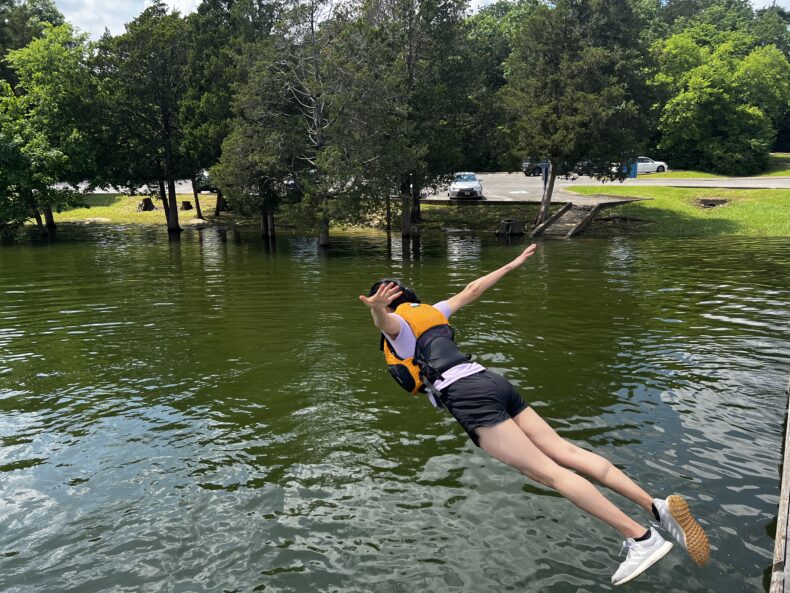
“We talk about the medicine related to altitudes, diving, hypothermia, hyperthermia, venomous snake bites, bleeding control, animal attacks, wound care and other topics,” Charnigo said. “We run through high-fidelity simulation sessions at CELA, the simulation lab at Vanderbilt. In the field, we run through a water rescue and talk about cold water immersion and drowning; they also come up with ways to stabilize and carry a person — slings, splints, litters — using only what’s available like camping and hiking equipment.”
In the end, the goal is to have second-year students who complete the course ready to step up to help save lives with the resources they have at hand, whether they’re on a remote trail or at a neighborhood grocery store. “It really reflects well on the students who sign up for this course,” said Jordan. “Yes, they’re getting outside the classroom, and it’s a lot of fun, but these students are taking a very intentional step to be a capable provider in these scenarios. They want to be there for their community, neighbors and friends.”


