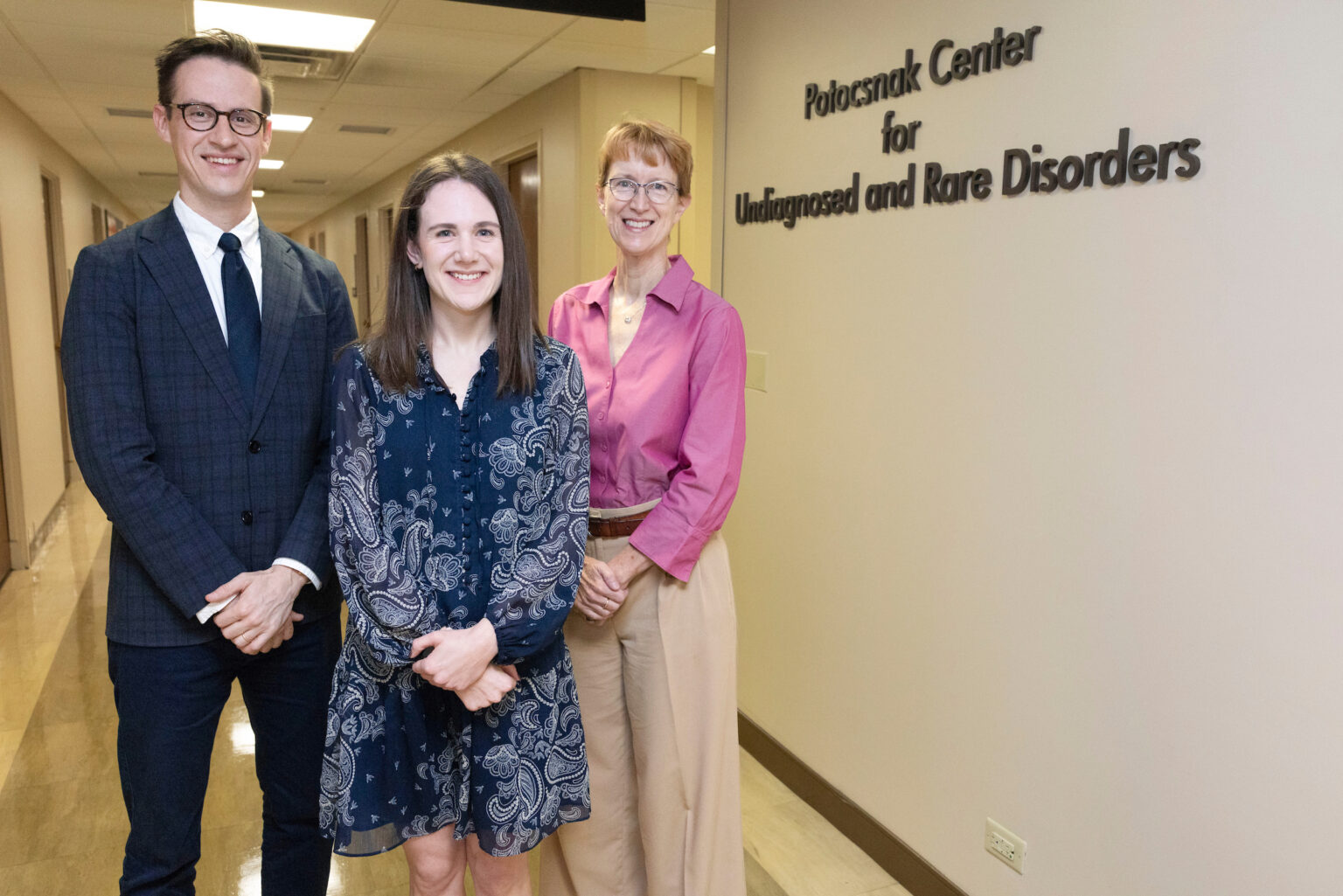
 Kevin Byram, MD, Erica Gray, MD, and Saralyn Williams, MD, and colleagues care for patients with undiagnosed diseases. (photo by Susun Urmy)

When a patient struggles through a fruitless journey to diagnose an uncommon disease, dealing with tests that reveal nothing out of the ordinary, symptoms that don’t respond to treatment or unexplained physical anomalies, that journey can begin to feel hopeless.
But those who are seen at the Potocsnak Center for Undiagnosed and Rare Disorders have access to a team of physicians, nurse practitioners, genetic counselors, bioinformatics professionals and more who work alongside them to find answers.
The Vanderbilt Undiagnosed Diseases Program, commonly referred to as the VUDP, exists within the Potocsnak Center to search for breakthroughs when all else has failed. It capitalizes on a foundational idea in medical practice: Pooling resources and knowledge from multiple disciplines results in better outcomes for patients.
Saralyn Williams, MD, Professor of Emergency Medicine, Medicine and Pediatrics, has over 30 years of clinical experience. Her specialty is medical toxicology, and she’s often brought in as the subject matter expert to add context to a case.
“The beauty of this program is the deeply collaborative interdisciplinary team, in which I get to hear not just my own opinion but the opinions of others,” Williams said.
Distinct career paths and timelines form a supportive clinical environment
The VUDP is also emblematic of the value of collaboration among clinicians at different career stages. Those newer to clinical practice not only hear from their more experienced colleagues but also contribute to making diagnoses. And, as Williams can attest, learning doesn’t stop at the early-career stage. She’s constantly learning from others who were in preschool when she finished her training.
“Learning about new technology, where it’s going and how fast it’s changing are what I get from being part of this group,” said Williams. “I feel extremely confident in my clinical skills, but I still get to learn from this team about the developing, foundational science behind what we’re observing.
“Think about how much genetics has changed since I went to medical school. Having the opportunity to absorb expertise from younger generations has been phenomenal to rejuvenate my curiosity.”
Erica Gray, MD, Assistant Professor of Clinical Pediatrics, is on the flip side of Williams’ career. Having just become an attending physician in 2025, she represents this latest generation of clinicians who bring knowledge to the conference room table that simply wasn’t in textbooks when their more seasoned counterparts were in training.
“I felt welcome and valued right away,” Gray said of joining the VUDP. “No thought is too small or too big. Everybody’s input, even if it’s one sentence or just agreement, is welcome … We are pushing boundaries and not setting limits on where we take our discussion. That then sparks other thoughts and may take us down a different avenue, but those ideas give us something to work off of.”
Williams said VUDP faculty members are good at avoiding groupthink; instead, they are willing to counter each other.
“Open conversation makes us better clinicians,” she added. “It makes me think a little more deeply about patients and how to prioritize what information I need, or what I need to synthesize from that information by getting insights from other clinicians.”
VUDP specialists lean on each other for cross-departmental collaboration. In Gray’s case, while medical genetics covers a patient’s entire lifespan, her focus on pediatrics has meant she hasn’t dedicated much of her clinical experience to adult patients.
“It’s really interesting hearing from my colleagues who treat adult patients in their subspecialties … It improves how I practice, too,” Gray said. “I feel immersed, engaged and comfortable reaching out to the colleagues I’ve met in this program.”
Solving a medical mystery takes a large team
An extraordinary amount of knowledge is pooled to attempt to reach a diagnosis for a patient with a rare disorder. Kevin Byram, MD, Associate Professor of Medicine in the Division of Rheumatology and Immunology, said the weekly genome data board is an embodiment of how many disciplines might be needed to solve one medical mystery.
“I wish patients could see, on the academic side, all the scientific teams coming together,” said Byram, adding that a single case reviewed by the board often comprises the work of 50 or more people.
There is also real “field experience” to be gained by meeting with a patient, Byram said. It’s valuable for doctors to be together for those consultations because there’s a lot to learn from how other clinicians ask questions or by understanding which aspects of a physical exam are most important to them.
“I’ve always relied on my colleagues in various disciplines, but it’s something else to be in the same room talking about a patient,” Byram said.
Patients play a key role in the collaborative diagnostic process
Patients being seen for a so-far undiagnosed disease often experience burnout from the process. Williams said the fragmented nature of seeing clinicians in multiple subspecialties who don’t interact directly to examine their case can lead to frustration.
“Often, no one is taking the reins to really help pull it all together for them,” said Williams.
Byram added that the uncertainty patients experience before being seen in the VUDP is only part of what weighs on them; there’s a lot of trauma, too. It’s exhausting telling their story over and over and continually not finding an answer. Thus, it’s important for the team to make sure patients know their input is crucial to working toward a diagnosis.
“It takes us being open-minded to see where the clues might come from,” said Byram.
Byram goes into each case with optimism that the patient might already have the information he needs and puts forth his best effort toward making a diagnosis.
“They’re going to tell you the answer if there is one,” he said. “You have to put the pieces together: the story, the labs, the biopsies, the imaging.”
Byram also conceded that it can weigh on a clinician to realize that some cases won’t progress to the point of a diagnosis.
“You set out to find answers, and sometimes you can’t, despite your best effort,” Byram said. “That’s a humbling thing, and it leads to the challenge of setting expectations. It’s a delicate thing for us to give a patient hope because we’re hopeful, too, and we’re going to work really hard. But in some cases, we can’t really find the answer.”
Doctors learn from patients, too
A common sentiment among those in the VUDP is the intrigue of solving the puzzles of medical mysteries. Byram went so far as to say that literature and pop culture TV shows like “Sherlock” and “House” influenced his desire to pursue medicine.
“I like thinking about patients as a puzzle; you’re just trying to find all the pieces and find the diagnosis and treatment,” Gray agreed. “You really get to do that through the VUDP.”
“Putting those pieces together in this setting requires multiple people looking at the puzzle,” said Williams, who called it an example of the whole being greater than the sum of its parts.
In putting the pieces together, Williams said, clinicians can learn a lot from their patients, as well as from the other doctors who treat them.
“You learn from the other generations who have a lot of experience and know the nuances of diseases very well,” said Williams. “You also hear doctors say, ‘I had this patient who made me rethink something.’ That is enormously rewarding for those of us who enjoy academic medicine.”