





Brian Wadzinski, PhD, is an affable bear of a man, a generous soul who loves the outdoors, animals and children.
He’s also an accomplished scientist, an associate professor of Pharmacology at Vanderbilt University who is driven by an insatiable curiosity to understand how nature works at the genetic, molecular and cellular levels, and how this knowledge can be applied to relieve the suffering of others.
About 15 years ago, Wadzinski’s love of science and the outdoors converged. He began to explore the powerful diagnostic and therapeutic potential of nanobodies, engineered fragments of unique antibodies found only in the blood of sharks and a family of hooved mammals that includes camels, llamas and alpacas.
To ensure a steady and economical source of these remarkable proteins, he helped establish an outdoor “laboratory” for alpacas on a farm in rural Humphreys County, about 80 miles west of Nashville.
Today, the alpaca enterprise, known formally as Turkey Creek Biotechnology LLC, is fueling nanobody research across the Vanderbilt campus and around the world. Early studies suggest that alpaca-derived nanobodies can thwart formidable bacterial and viral infections, speed cancer diagnosis, and illuminate the origins of brain disorders including Alzheimer’s disease.
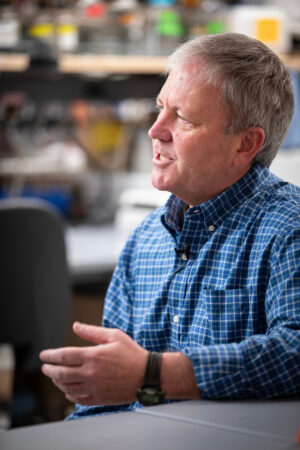
Since he was a postdoctoral research fellow in the early 1990s, Wadzinski, 65, has studied the structure, function and regulation of protein phosphatase 2A (PP2A), an enzyme that plays important roles in numerous cellular functions including cell division, growth, metabolism and differentiation.
He continued his investigations after joining the Vanderbilt faculty in 1993. But by 2010, the research had stalled. Government funding was drying up. “I had to think outside the box — try to come up with something to keep me going,” Wadzinski said.
That’s when he heard about nanobodies, protein fragments about one-tenth the size of antibodies. They’re quite stable and bind tightly to antigens, markers on the surfaces of invading microbes, other pathogens and our own cells — even inside the brain and other places antibodies can’t go because they’re too big.
About that time, Wadzinski and his wife, Claudia, purchased a cabin in the woods a few miles north of Waverly, Tennessee, for their boys, who loved to hunt and fish.
“Wouldn’t it be neat,” he thought, “to be able to do some biotechnology out here, to merge this country environment with science?”
Ben Spiller, PhD, a research colleague and associate professor of Pharmacology at Vanderbilt, agreed that a homegrown enterprise could be more economical and provide more flexibility than buying antibodies from a biopharmaceutical company. The duo began exploring the possibility of keeping a herd of alpacas on the Wadzinskis’ property.
A higher purpose
When neighbors Randy and Janet Litton, who harvest hay from their 318-acre farm down the road, heard about the plan, they offered the use of a barn, paddocks and some of their rolling pastures to house and care for the animals.
Their 31-year-old son, Edwin, died from cancer in 2011. “I want to help,” Randy Litton said. “If I can keep somebody else from going through this, I’d like to do that. I want this project to succeed.”
While Litton knows that nothing can bring his son back, there’s something healing about putting the land upon which Edwin ran as a child to a higher purpose.
“You want to know where I see God?” he asked. “Look around. This is God.”
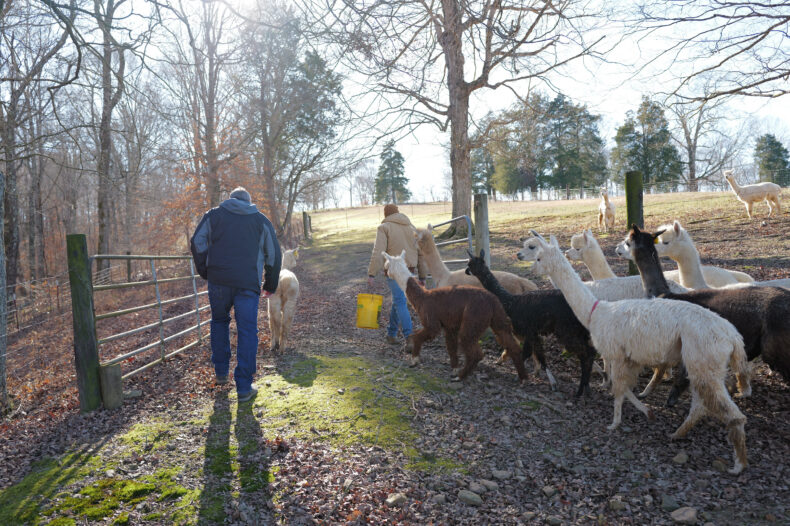
Nanobody production at Turkey Creek Biotechnology begins with 18 inquisitive, furry, big-eyed creatures that weigh up to 150 pounds and stand 5 to 6 feet tall when fully grown.
Alpacas are normally gentle and pleasant animals except when they are competing for chow at feeding time. Then they will grumble, spit at each other (and any human who gets in the way), and sometimes bite.
Each has a name — Clover, Juliet Loiie, Sundae Surprise — and a distinct personality to match. “They’re really cool animals,” Wadzinski said with a chuckle.
Miracle, one of the first alpacas to participate in the research, died last year. She was close to 20, an old age for animals that generally live 15 to 18 years.
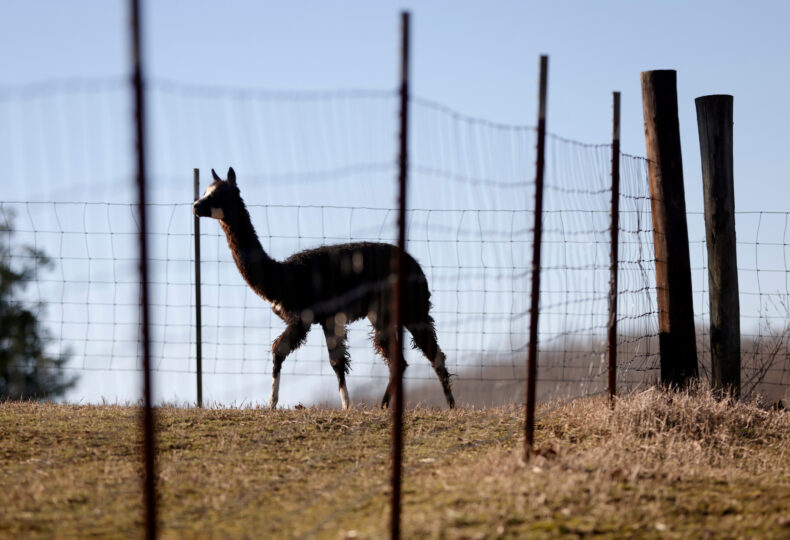
The study begins when the alpacas are injected with a harmless antigen from the pathogenic microbe, cell or molecule that is being investigated.
In response to the antigenic challenge, immune cells in the blood produce the near-ubiquitous four-chain antibodies found in mammals, reptiles, birds and some fish, as well as two-chain proteins, called “heavy chain” antibodies, that are unique to alpacas and their close relatives.
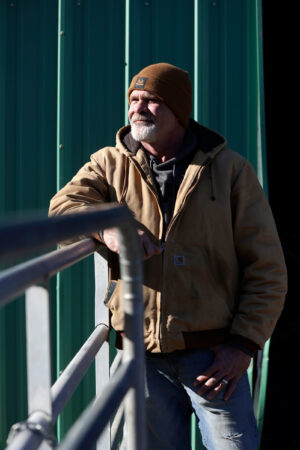
Dave Harville, the farm manager and the alpacas’ primary caretaker, handles the injections and, two months later, transports the animals via livestock trailer to a veterinarian’s office in Waverly, where blood samples are drawn. Wadzinski then drives the samples to Nashville for processing in his Vanderbilt lab.
Scott Bury, PhD, director of the Office of Animal Welfare Assurance at Vanderbilt, monitors the research as a member of the Institutional Animal Care and Use Committee, to ensure all federal rules and regulations regarding the use of animals in research are being followed.
From the blood cells that produce heavy chain antibodies, Wadzinski’s lab isolates the genetic material encoding only the active, antigen-binding fragments. Spiller’s lab uses molecular engineering techniques to clone and mass-produce the fragment targeting the antigen being studied.
“You take out of the DNA just the small fragment that encodes the binding element,” Spiller explained. “Then we make large libraries of those and isolate the ones that have the characteristics we want.”
From pasture to lab bench
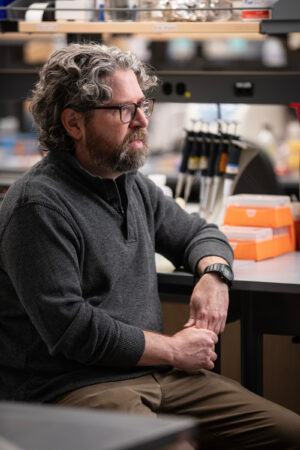
To test their farm-to-lab approach, the researchers recruited Spiller’s wife, Borden Lacy, PhD, the Edward and Nancy Fody Professor of Pathology and director of the Vanderbilt Center for Structural Biology. Her lab is developing vaccines and therapeutic antibodies against Clostridioides difficile, a notoriously resistant bacterium that infects the colon.
Toxins released by the bacterium trigger destructive inflammation that disrupts the colon’s protective lining, causing chronic diarrhea and intestinal pain. Overuse of antibiotics exacerbates the problem. In older patients who are immunocompromised, on antibiotics, or hospitalized, a severe “C. diff” infection can lead to sepsis, multiple organ failure and death.
Lacy’s team is using alpaca-derived nanobodies to better understand and neutralize the bacterial toxins and, ultimately, prevent recurrent C. diff infections.
Early, preclinical results are encouraging. The ability to screen for nanobodies in the lab that recognize defined protein epitopes — antigen “binding sites” — accelerates the discovery process and improves the success rate, Spiller noted.
For another proof of the alpaca concept, the researchers brought in Lawrence Marnett, PhD, the Mary Geddes Stahlman Professor of Cancer Research, University Distinguished Professor of Biochemistry and Chemistry, and Dean Emeritus of the School of Medicine Basic Sciences.
During his 37-year career at Vanderbilt, Marnett has applied structure-based approaches and medicinal chemistry to design selective inhibitors of the cyclooxygenase-2 (COX-2) enzyme to improve the treatment of inflammation and prevent cancers driven by overexpression of the enzyme.
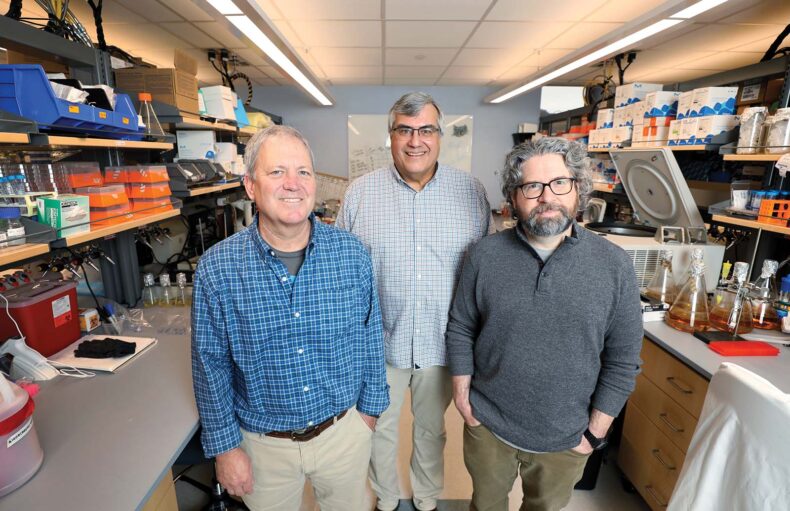
His colleague, Jashim Uddin, PhD, research associate professor of Biochemistry, has attached fluorophores (molecules that fluoresce) to alpaca-derived nanobodies targeting COX-2. The goal is to improve early detection of colorectal cancer, a leading cause of cancer-related mortality in the United States. Earlier detection enables earlier treatment — and better outcomes.
“We would never have done anything like this with monoclonal antibodies,” Marnett said. “They’re too big … When Brian and Ben partnered in the alpaca farm, that gave us a whole new dimension that we just didn’t have.”
Currently Wadzinski and Spiller are collaborating with more than a dozen scientists at Vanderbilt and around the country to provide alpaca-derived nanobodies for multiple projects.
“A colleague in Minnesota has been making antibodies against all sorts of emerging viruses,” including Ebola, Spiller said. “It’s part of a national effort to be better prepared” for the next pandemic.
Recently, Ivelin Georgiev, PhD, the Louise B. McGavock Professor and director of the Vanderbilt Program in Computational Microbiology and Immunology, and his colleagues have adapted an antibody discovery tool they developed to speed the identification of antigen-specific nanobodies.
The high-throughput technique, called LIBRA-seq (Linking B-cell Receptor to Antigen Specificity through Sequencing), enables the simultaneous identification of nanobodies targeting several antigens of interest, as well as nanobodies that react against more than one antigen.
Turkey Creek Biotechnology does not receive any direct funding from Vanderbilt or the federal government. The alpaca herd is supported by the nanobody researchers themselves.
The return on their investment comes in the form of new grants and scientific publications that can take their research to the next level. “It’s really helped rejuvenate my research program,” Wadzinski said.
Guardian angels
About eight years ago, Wadzinski got a call from Jordan’s Guardian Angels (JGA), a nonprofit organization based in Sacramento, California, that raises awareness and funds for research to benefit children born with Jordan’s syndrome, a rare genetic disease that causes neurodevelopmental delays and which is often mistaken for autism.
“Jordan’s syndrome turns out to be a de novo (spontaneously arising) mutation in a PP2A subunit, an enzyme that I’ve worked on through my whole career,” Wadzinski said.
Founded in 2014, JGA supports a group of nine investigators across the country and one in Belgium who are studying the disorder and developing and testing various small molecule and gene therapy approaches to treat and perhaps even cure it.
A Phase 2 clinical trial is currently underway in the United States with patients with Jordan’s syndrome to determine the safety and efficacy of an investigational drug to reduce inflammation and improve cognitive function.
After learning about Wadzinski’s work, leaders of JGA invited him to join their research team and began to support his research. His role has been to develop tools for studying the disorder — antibodies and nanobodies that target the protein mutated in Jordan’s syndrome.
The project has become very personal. Wadzinski and his colleagues have invited the families of children with Jordan’s syndrome to visit the farm, and they’ve attended research updates during JGA family conferences.
Individuals with Jordan’s syndrome are an “awesome” inspiration, Wadzinski said. “Getting to know them has been the biggest motivation behind the research I’ve been doing.”
Every spring, the alpacas’ thick fleece is sheared. A local mill spins the fiber into yarn, which a team of women knits into hats, scarves and stuffed toy alpacas.
The silky toy products are auctioned online to help support JGA-sponsored research. Most of the alpaca hats have been knitted by local volunteer Louann Young and given to patients at the Vanderbilt-Ingram Cancer Center. “They can bring a little happiness to somebody who’s going through a hard time,” Wadzinski said.
Some of the transformed fleece was Miracle’s.
“In a lot of ways,” he said, “this project turned out to be a miracle because it worked.” Plus, outside activities — the hats, networking in the community — all of it has been a “wonderful, jaw-dropping experience.”
Perhaps, he mused, this journey from basic research to an alpaca farm and back to the lab again shows how serendipity and “outside-the-box” thinking can change the world for the better.