melanoma Archive — Page 3 of 3

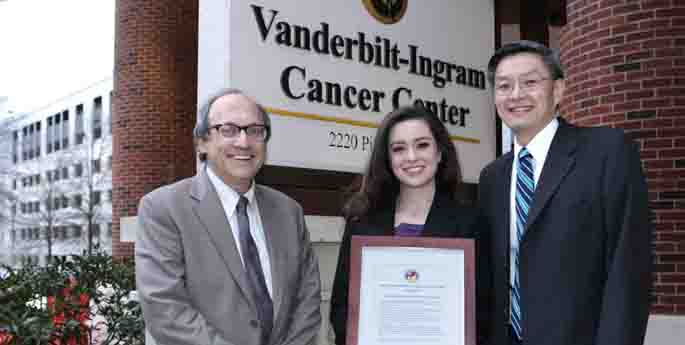
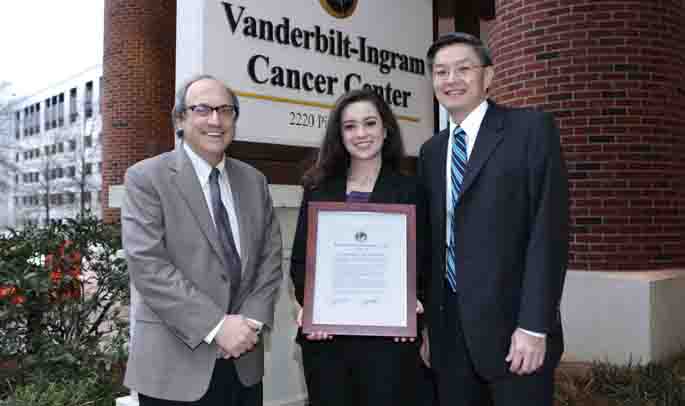
Three people pose outside the Vanderbilt-Ingram Cancer Center; the person in the center holds a framed award certificate.
December 19, 2013

VU study identifies new gene fusions in melanoma

Cancer researchers, led by investigators at Vanderbilt-Ingram Cancer Center, have identified two novel gene fusions in melanoma that may be responsive to existing cancer therapies. Melanoma is the most deadly form of skin cancer.

Three people pose outside the Vanderbilt-Ingram Cancer Center; the woman in the center holds a framed award certificate, flanked by two men in suits. The building sign is visible behind them.
March 28, 2013

Foundation lauds graduate student’s melanoma research

Katherine Hutchinson, a third-year graduate student in Cancer Biology at Vanderbilt University, has won a $10,000 Research Scholar Award from the Joanna M. Nicolay Melanoma Foundation.

October 25, 2012

Combined drug therapy may delay melanoma progression

Combination therapy with two drugs delayed the development of treatment resistance in patients with metastatic melanoma that expresses a specific mutation in the BRAF gene.

Glowing white DNA double helix against a blue digital circuit-board background.
July 26, 2012

Study finds mutation in melanoma sensitive to drug

An uncommon mutation of the BRAF gene in melanoma patients has been found to respond to a specific drug therapy, providing a rationale for routine screening and therapy in melanoma patients who harbor the BRAF L597 mutation.

Close-up of a person's sun-exposed shoulder at the beach, with white sunscreen arranged in a sun-shaped pattern on the skin.
April 26, 2012

New drug mutes more melanomas

An experimental melanoma drug may be beneficial for patients not eligible for targeted therapies.

Close-up of a middle-aged man’s eyes, forehead, eyebrows, and upper nose, with a dark spot visible on his forehead.
January 26, 2012

Investigators seek clues to resistance to melanoma drug

Investigators at Vanderbilt-Ingram Cancer Center and several other centers may be one step closer to finding out why some melanoma patients relapse after treatment with a promising new drug.