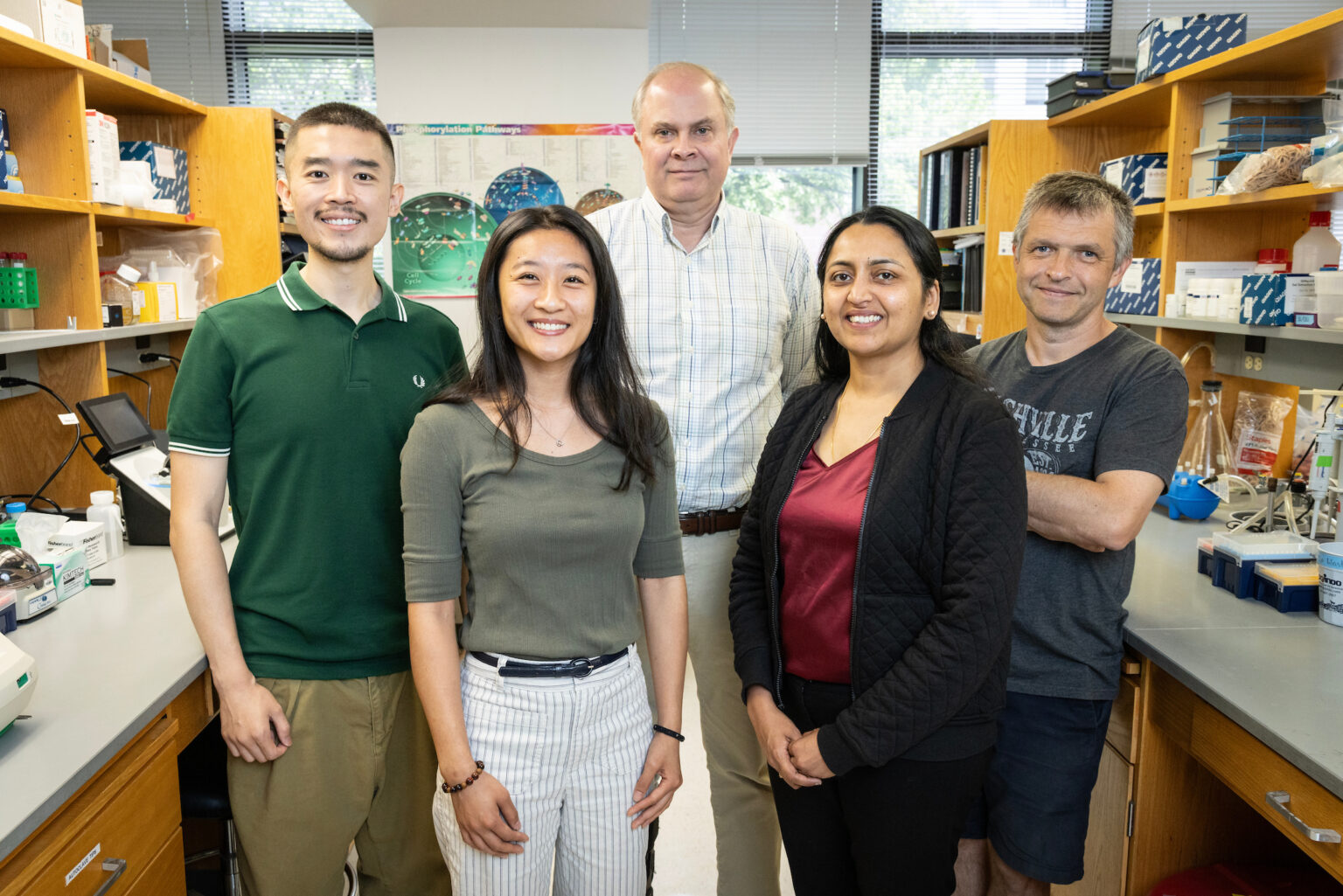
 Jerod Denton, PhD, center, poses with members of his research team, from left, Kangjun Li, PharmD; Samantha Le, Vaishali Satpute, PhD, and Roman Lazarenko, PhD. (photo by Erin O. Smith)

Three drugs prescribed to prevent asthma attacks also activate an important ion channel that has been genetically linked to Parkinson’s disease, researchers at Vanderbilt Health have found.
Their report, published in the April issue of the American Journal of Physiology-Cell Physiology, suggests that drugs approved by the Food and Drug Administration for other conditions might be repurposed to restore normal cell function in neurodegenerative disorders such as Parkinson’s disease.
The ion channel, TMEM175, is found in the membranes of lysosomes, organelles that, among other roles, regulate neurologic and immune function. Genetic variants that “turn down” TMEM175 activity have been linked to an increased risk for Parkinson’s disease.
Using the Vanderbilt High-Throughput Screening (V-HTS) Facility, the researchers screened 960 FDA-approved drugs for those that activate TMEM175. Three asthma drugs stood out as entry points for developing potential new Parkinson’s treatments: zafirlukast (Accolate), pranlukast (Onon), and montelukast (Singulair).
“In the near term, we hope our findings will provide researchers with immediately usable compounds to study how this channel works in cells and in disease models, without needing to develop new drugs from scratch,” said the paper’s corresponding author, Jerod Denton, PhD, Professor of Anesthesiology and Pharmacology.
“Our highest translational goal is to develop new therapies that enhance TMEM175 activity to restore lysosomal function in Parkinson’s disease, helping cells better manage stress and waste buildup that contribute to neurodegeneration,” Denton said.
“More broadly, we hope to establish TMEM175 as a druggable target across multiple neurodegenerative and lysosome-related disorders, opening a new therapeutic strategy focused on restoring intracellular homeostasis,” he said.
Last month, Denton was honored during Vanderbilt University School of Medicine’s annual Spring Faculty Assembly for Outstanding Contributions to Research. His work has informed the development of therapeutics for neuropsychiatric, kidney and metabolic disorders.
Kangjun Li, PharmD, a pharmacology graduate student in the Denton lab, was the paper’s first author.
Other Vanderbilt co-authors were Samantha Le, also a pharmacology graduate student in the Denton lab; Vaishali Satpute, PhD, staff scientist, and Roman Lazarenko, PhD, research instructor, in the Department of Anesthesiology; Emily Days, senior research analyst in the Vanderbilt Institute of Chemical Biology (VICB); and Joshua Bauer, PhD, Director of the V-HTS Facility.
Denton attributed the success of the project to the “critical intellectual partnership” of scientists in his lab and the V-HTS Facility, which was established by VICB in 2005.
“A key strength of our approach was the integration of high‑throughput compound discovery with mechanistic follow‑up to rapidly identify and validate modulators of TMEM175,” he said. “This unique infrastructure allowed us to quickly identify candidate activators and prioritize compounds with translational potential.
“These drugs don’t all work the same way,” Denton noted. “Some activate the channel directly, while others depend on upstream signaling pathways, giving us new insight into how the channel is regulated inside cells.
“We identified the part of the channel that controls how it opens, and responds to drugs,” he added. “By pinpointing key regions that act like a ‘gate,’ we now have a clearer road map for designing better, more targeted therapies in the future.”
Denton said his group’s experience highlights how “indispensable” the V-HTS facility is to Vanderbilt’s drug discovery efforts. Supported by Vanderbilt University and grants from the National Institutes of Health (including grant S10OD021734), the facility, he said, is “a uniquely powerful bridge between basic science research and translational impact.”