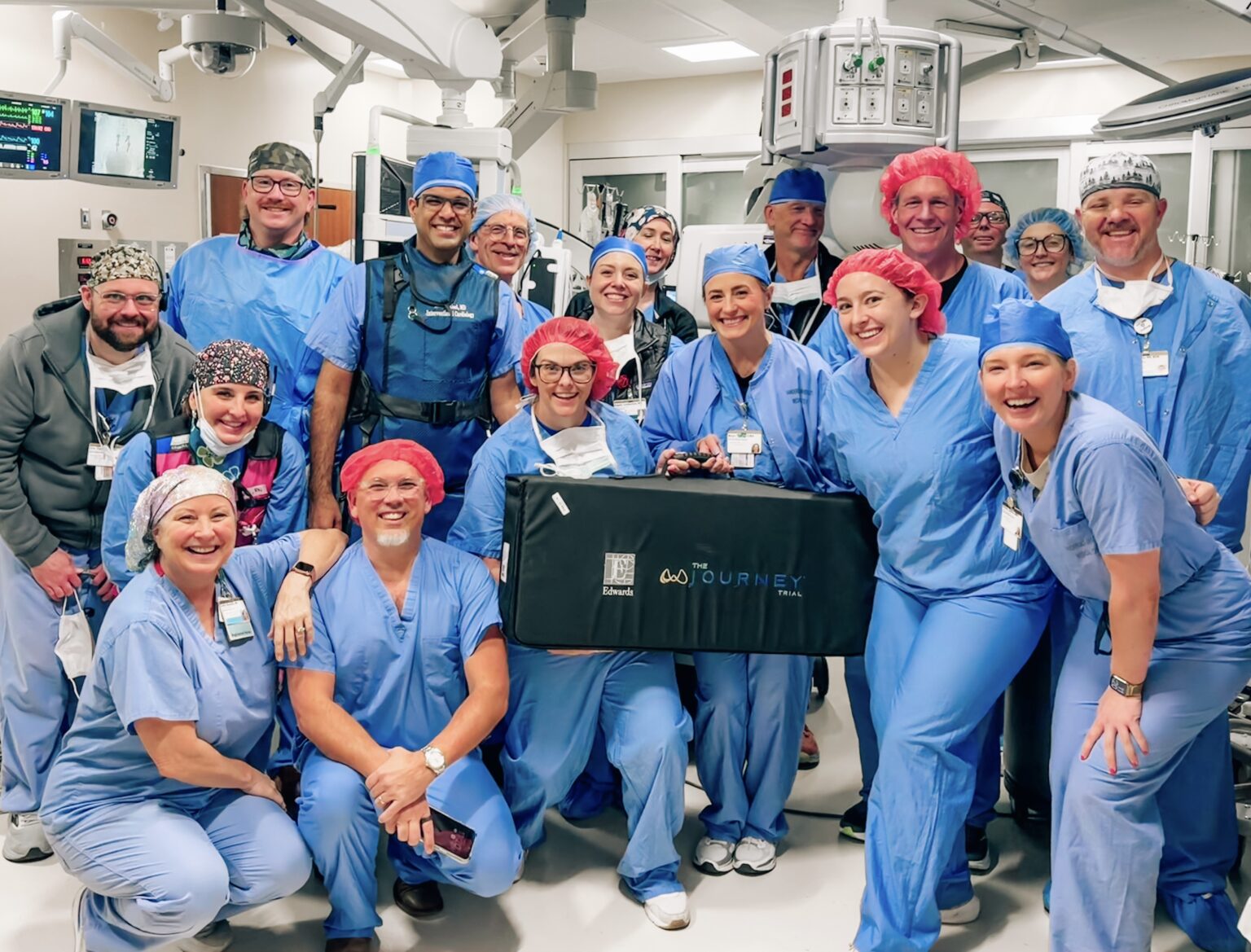
 Dixie Watt of Brentwood, Tennessee, was one of the first patients to get the M3 device, the first FDA-approved transseptal transcatheter mitral valve replacement. (photo by Donn Jones)

Patients at a high risk for surgery with moderate to severe mitral regurgitation, severe mitral stenosis or moderate mixed mitral valve disease have a new, minimally invasive option at the Vanderbilt Heart and Vascular Institute (VHVI).
Starting in June, VHVI began implantations of the M3 device, the first Food and Drug Administration-approved transseptal transcatheter mitral valve replacement. It is the latest in an array of catheter-delivered devices offered by the Structural Heart and Valve Center at VHVI for high-risk patients who would otherwise have limited or no options for treatment.
Minimally invasive procedures use a catheter to place a small device in the valves to reduce the opening and prevent the backflow of blood. The procedures are relatively quick and painless compared to surgical alternatives, and patients typically require a significantly shorter stay in the hospital to recover.
Kashish Goel, MBBS, Associate Professor of Medicine and Director of Transcatheter Heart Valve Interventions at Vanderbilt Health, said that prior to the M3 device, the only FDA-approved option for mitral valve regurgitation patients was transcatheter edge-to-edge repair, which was not an option for many patients. Various trials of other devices are also available for patients who are not candidates for the M3 device.
“We have a full breadth of technologies that most centers in the country don’t have,” Goel said.
Dixie Watt of Brentwood, Tennessee, was one of the first to get the device at Vanderbilt Health. Before her implantation, doctors made two attempts at transcatheter edge-to-edge repair. Both failed, Goel said.
Watt was very short of breath and even small tasks like walking upstairs to bed were difficult. Now, after the M3 procedure, she is breathing better and returning to a more active lifestyle.
“I think this would really help people with mitral valve regurgitation,” Watt said. “I think it’s something new where you don’t have to have open-heart surgery. And I think it’s great.”
Minimally invasive, catheter-based devices are now available at VHVI to treat aortic, mitral and tricuspid heart valve disorders. Transformative innovation over the last few decades has changed the landscape and treatment options for patients with heart valve disease. Numerous devices have been approved and many others in development and testing.
“This really opens a new era where we will be able to, as a part of our multidisciplinary valve program, have options for people who just a year ago we were declining or trying to come up with creative, off-label options,” said Colin Barker, MD, Director of the Section of Interventional Cardiology and Associate Professor of Medicine. “This device is safe and effective in the right patient, who is generally elderly, frail, with multiple comorbidities, but typical for the referrals we receive, both to cardiac surgery and interventional cardiology. These are people who have sometimes been through two or three other heart centers by the time they get to us.”
Patients who receive the M3 device typically arrive on the morning of the procedure, Goel said. They receive a CT scan and a transseptal echocardiogram, a diagnostic ultrasound that creates detailed images of the heart. Clinicians then confirm whether the patient is a candidate for the procedure. If so, the procedure takes about two hours under general anesthesia. Patients will typically spend one night in the hospital, then return home. They return for a follow-up appointment in a month.
“This is something that our referring providers have wanted for a long time and are excited about the technology that we have,” said Melissa Long, MSN, RN, Valve Program Coordinator. “There is a patient population that has been underserved, and now they’re ready to be treated.”