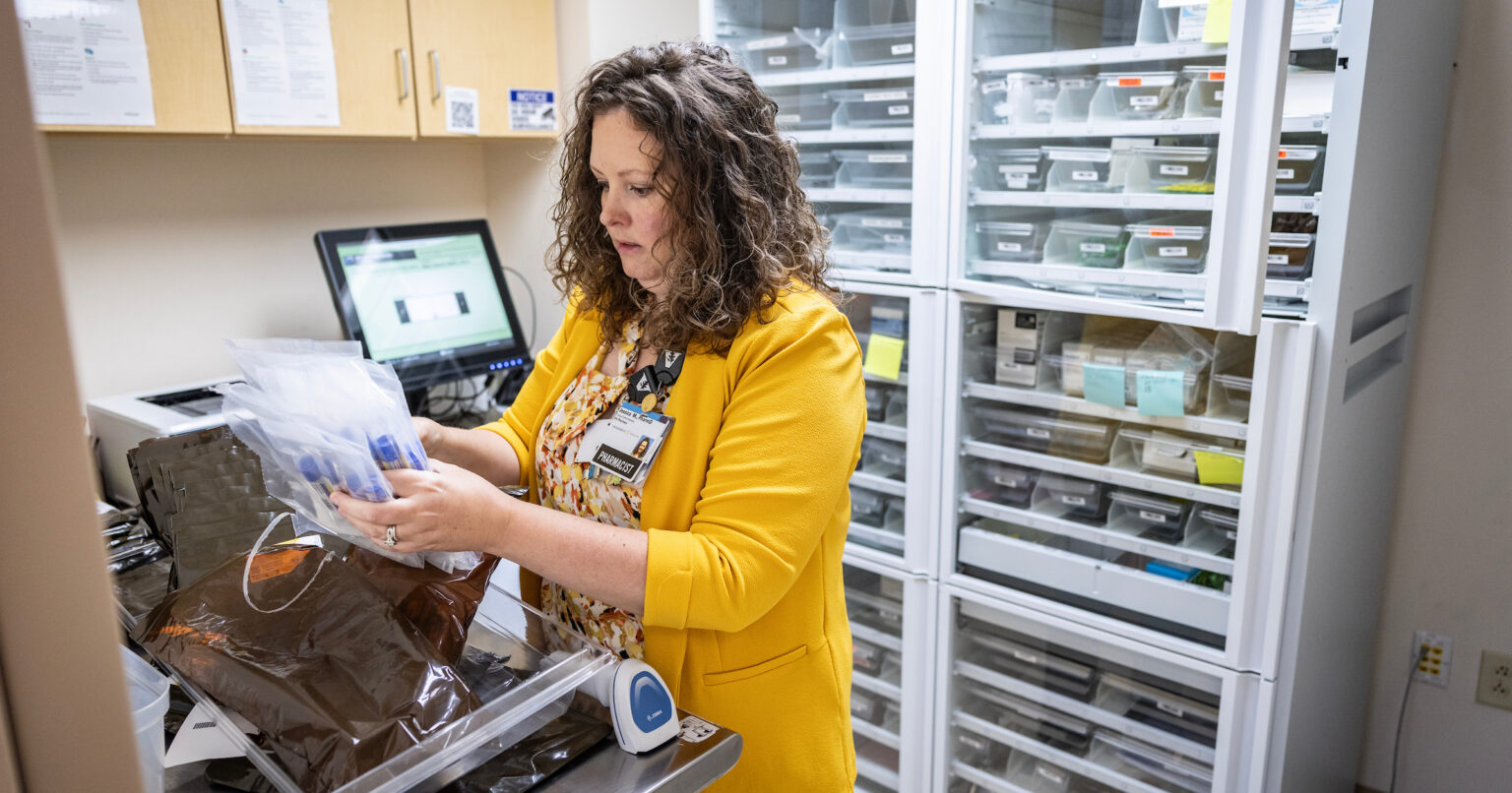
 Jessica Matlock, PharmD, works in control substance receiving at the pharmacy at Vanderbilt Bedford Hospital. (photo by Erin O. Smith)

Three Vanderbilt Health Regional Hospitals beat systemwide targets last year for reducing use of vancomycin, a powerful antibiotic often reserved for serious infections: Vanderbilt Bedford Hospital (VBCH), Vanderbilt Tullahoma-Harton Hospital (VTHH) and Vanderbilt Wilson County Hospital (VWCH).
“They really hit it out of the park. All three hospitals exceeded the goal and we are glad to have Vanderbilt Clarksville Hospital (VCH) part of the effort now,” said Ritu Banerjee, MD, PhD, Executive Medical Director of the Vanderbilt Antibiotic Stewardship Program (ASP) and Professor of Pediatrics, Pediatric Infectious Diseases.
The results are part of an enterprise-wide effort to make sure antibiotics are used only when needed, and in the safest, most effective way possible, she said. The goal is to bring the same data-driven quality and safety work found at the academic medical center to community hospitals that serve patients close to home.
Every Regional Hospital, along with Vanderbilt University Hospital (VUH) and Monroe Carell Jr. Children’s Hospital at Vanderbilt, now tracks antibiotic stewardship metrics and reports its progress to leadership. Each also takes part in systemwide improvement efforts led by physicians, pharmacists, quality leaders and clinical informatics experts.
This year, as U.S. Antibiotic Awareness Week approaches, VH teams at regional hospitals are focused on another evidence-based initiative: helping patients move from intravenous antibiotics to oral medications when it’s safe and clinically appropriate.
Research consistently shows that patients who can switch to oral therapy often leave the hospital sooner, avoid complications associated with IV treatment and experience lower overall costs of care, said Banerjee.
The work is possible because Regional Hospitals now have access to the same stewardship infrastructure used across Vanderbilt Health, including shared reporting dashboards, electronic medical record tools and quality oversight processes that allow leaders to track antibiotic use and outcomes across facilities.
The program creates stronger connections between local care teams and systemwide experts.
“Every hospital has a physician medical director and a pharmacist co-leader in charge of stewardship activities,” Banerjee said. “We’re able to standardize activities across the health system and visualize the impact of our interventions across the health system.”
The regional stewardship successes come as health systems across the country prepare to observe U.S. Antibiotic Awareness Week, Nov. 18-24, an international campaign focused on preserving the effectiveness of antibiotics and combating the rise of drug-resistant infections.
For Banerjee, however, stewardship is far more than a once-a-year initiative.
Antibiotics save lives and remain essential for treating serious bacterial infections such as pneumonia, strep throat, urinary tract infections and bone infections. Yet antibiotics do not treat viruses, and unnecessary use can expose patients to side effects ranging from allergic reactions and severe diarrhea to complications that require emergency care.
Overuse of antibiotics contributes to antimicrobial resistance, a growing global challenge that makes infections harder, and sometimes impossible, to treat.
“If our antibiotics no longer work, then we are potentially going to end up in a pre-antibiotic era when there were fatal and untreatable infections,” Banerjee said.
This is driving the next phase of stewardship work across Vanderbilt Health’s hospitals and clinics, she said.
Along with monitoring antibiotic prescribing, teams are expanding efforts into diagnostic stewardship, helping clinicians avoid unnecessary testing that can lead to unneeded treatment. Future initiatives include improving adherence to clinical guidelines, evaluating the cost-effectiveness of stewardship interventions, and expanding stewardship practices in surgical care settings.
For patients, Banerjee’s message is straightforward: Antibiotics are lifesaving when needed, but not every illness requires an antibiotic prescription.
VH stewardship teams have designed a brief quiz as an additional resource for parents and caregivers who want to know when antibiotics are necessary.
Meet the team
- Ritu Banerjee, MD, PhD – Executive Medical Director of the VUMC ASP
- Milner Staub, MD, MPH – Medical Director of Adult ASP
- Kaitlyn Reasoner, MD – Medical Director of Adult Outpatient ASP
- Sharon Ong’uti, MD, MPH – Medical Director of ASP at VUH
- Nicholas Herrera, MD – Medical Director of ASP at VBH and VTHH; Associate Medical Director of ASP at VUH
- Augusto Dulanto Chiang, MD – Associate Medical Director of ASP at VUH
- Chance Askins, PharmD – ASP Pharmacist, VBH
- Laura Bobbitt, PharmD – ASP Pharmacist, VUH
- Christo Cimino, PharmD – ASP Pharmacist, VUH
- Febronia Dawoud, MD – Medical Director of ASP at VWCH
- Jessica Duke, PharmD – ASP Pharmacist, VTHH
- Ben Ereshefsky, PharmD – ASP Pharmacist, VUH
- Kelly Gamble, PharmD – ASP Pharmacist, VUH
- Austin Ing, PharmD – ASP Pharmacist, VUH
- Trudy Jackson, PharmD – ASP Pharmacist, VCH
- Dina Mikaiel, PharmD – ASP Pharmacist, VWCH
- Alex Taylor, PharmD – ASP Pharmacist, VUH
- Sarah Tran, MD, MPH – Medical Director of ASP at VCH
- An Vo, PharmD – ASP Pharmacist, VTHH
- Sophie Katz, MD, MPH – Medical Director of Pediatric ASP
- Joshua Doyle, MD, PhD – Associate Medical Director of Pediatric ASP
- Jessica Gillon, PharmD – Pediatric ASP Pharmacist