


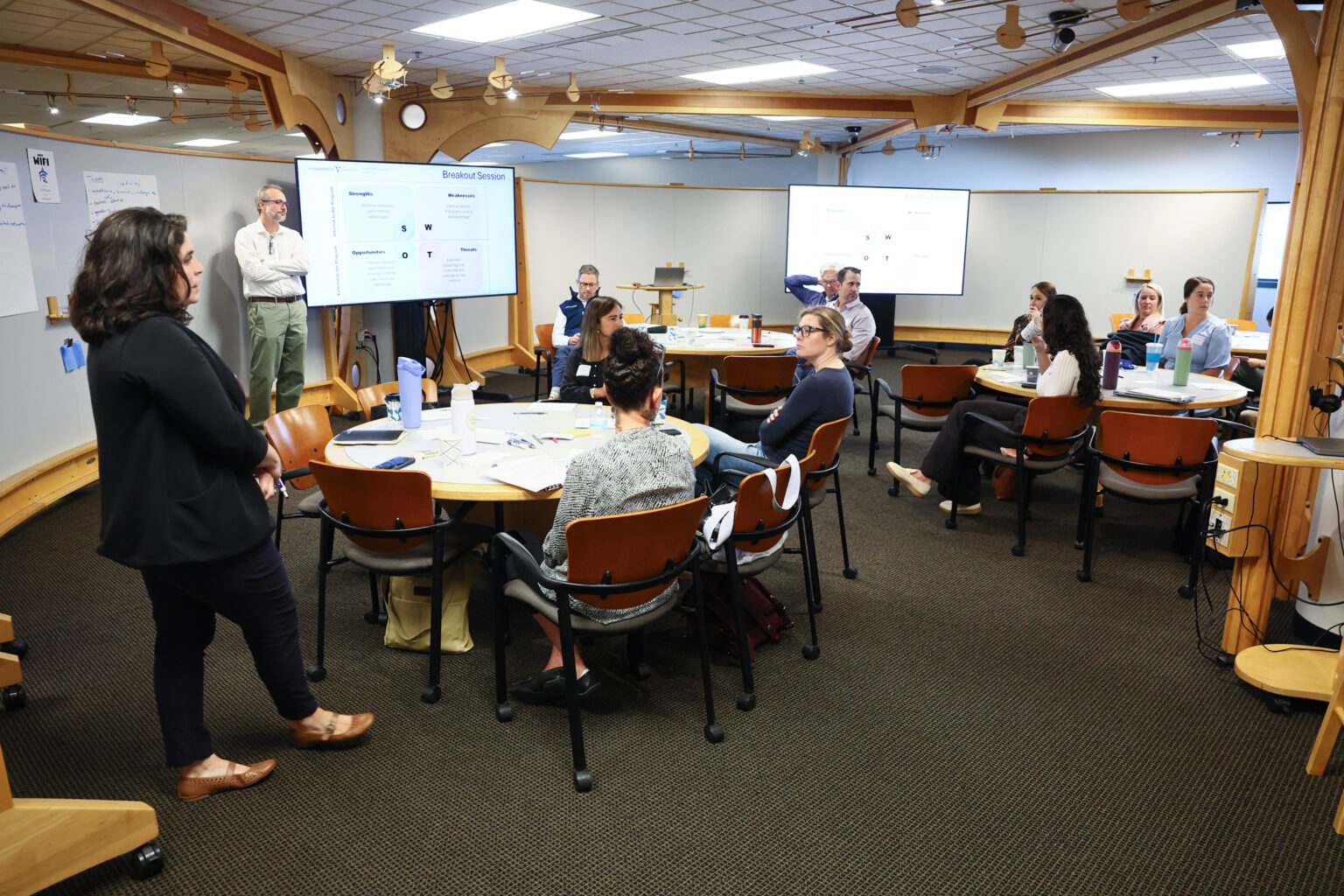
 Participants gather for a session at a recent retreat for the Adult Congenital Heart Disease program at Vanderbilt Health. (submitted photo)

Recently, a multidisciplinary team of about 50 experts gathered to celebrate the successes — and chart the future growth — of the Adult Congenital Heart Disease (ACHD) program.
The number of experts — from cardiology, cardiac surgery, cardiac anesthesia, interventional cardiology, electrophysiology, nursing, transplant specialists and administrative leadership — exemplified just how much the ACHD program has grown along with increasing demand from patients.
At the root of its success: Patients with congenital heart disease, many of whom did not survive to adulthood 40 years ago, now mostly have normal life expectancy. As more patients have lived into adulthood, they gave birth to the field of ACHD and a growing need for providers to manage this unique group of patients. It has created the need for an enterprise that treats people from before birth throughout the course of life.
“Institutionally, there has been a big investment in ACHD care,” said Angela Weingarten, MD, MSCI, Assistant Professor of Medicine and Pediatrics and Co-Director of the Adult Congenital Heart Disease section within the Division of Cardiovascular Medicine, along with Benjamin Frischhertz, MD, Associate Professor of Medicine and Pediatrics.
“Born out of that need of more patients and not enough places,” Frischhertz said, “Vanderbilt Health has been aggressively building its ACHD program over the last couple of years. This is a big team.”
Congenital heart disease encompasses a wide range of cardiac conditions that begin before birth, affecting between 1% and 2% of births. Many of those patients will require initial surgeries as infants, perhaps later surgeries as young adults and more into adulthood, with medical management in between. Some may develop heart failure and require a heart transplant.
Vanderbilt Health’s program allows patients to seamlessly transition from the Golisano Pediatric Heart Institute at Monroe Carell Jr. Children’s Hospital at Vanderbilt to the adult program at Vanderbilt University Hospital and to continue to receive the specialized cardiac care that they require. In the last 18 months, the adult program has added two cardiologists and is in the process of onboarding a third, as well as increasing nursing support.
Recent additions include Ryan Byrne, MD, Assistant Professor of Medicine and Pediatrics; Stephanie Fuentes Rojas, MD, Assistant Professor of Medicine; and Yishay Orr, MBBS, PhD, Associate Professor of Cardiac Surgery. Steven Healan, MD, is joining soon. The recent expansion of the catheterization (cath) lab is allowing more ACHD services.
“We want to be the best program in the country, and I think Vanderbilt is uniquely structured to be able to allow that to happen in that we are one medical center,” Weingarten said. “We have a very strong pediatric heart center and a very strong adult heart center. Our patients reap the benefits of both sides, and it is seamless. We can always provide the most expert care no matter where it comes from, which is very different than other heart centers.”
She gave an example: A recent patient had a very complex congenital heart surgery and recovered in the adult cardiac intensive care unit. That patient had a stroke, but went immediately for neurointerventional radiology, received a thrombectomy, then crossed over to Monroe Carell for a congenital catheterization at its cath lab, and then recovered in the adult ICU.
“That’s very unique to Vanderbilt,” Weingarten said. “That kind of care cannot be achieved in other places.”
Part of the recent gift from entrepreneur, philanthropist and civic leader Tom Golisano to Monroe Carell is earmarked for lifelong care of congenital heart disease patients, Frischhertz said. In recognition of Golisano’s generosity, the hospital’s nationally ranked heart care and surgery program was renamed the Golisano Pediatric Heart Institute.
Monroe Carell is home to one of the nation’s earliest congenital heart disease and pediatric heart transplant programs. Co-led by Carlos Mery, MD, MPH, Chief of the Division of Pediatric Cardiac Surgery and holder of the Monroe Carell Jr. Chair, and Larry Markham, MD, Chief of the Division of Pediatric Cardiology and holder of the Katrina Overall McDonald Chair in Pediatrics, the Golisano Pediatric Heart Institute has one of the country’s largest pediatric heart transplant programs and among the largest electrophysiology and interventional cardiology programs.
Markham was recruited back to Vanderbilt Health in April from Riley Children’s Health in Indianapolis for the pediatric role; he previously served as Adult Congenital Heart Disease program director at Vanderbilt Health for a decade.
“Congenital heart disease is no longer just a childhood condition,” said Markham and Mery. “As most patients are expected to live well into adulthood, they require expert, lifelong care that evolves with their needs. What sets Vanderbilt Health apart is our ability to deliver that care seamlessly across one integrated system working hand in hand across the age continuum to ensure the best possible outcomes for patients and families.”
Even in Markham’s new pediatric role, he is also seeing adult patients, Weingarten said.
The pediatric team provides highly specialized care for the full spectrum of heart disease, serving more than 20,000 children each year through 10 satellite clinics across Tennessee and partnering with Vanderbilt Health adult heart teams to ensure continuity of care from fetal diagnosis through adulthood. Each year, the pediatric team performs more than 500 cardiac surgeries, and in fiscal year 2026, performed 19 heart transplants.
“The success of congenital heart surgery has fundamentally changed what it means to care for these patients,” said Ziv Beckerman, MD, Associate Professor of Cardiac Surgery, Associate Chief of Pediatric Cardiac Surgery, Director of Adult Congenital Heart Surgery, and Surgical Director of Pediatric Heart Transplantation. “Our patients are growing up, building families and living full lives, and our responsibility is to grow with them. We need to be prepared to care for patients with congenital heart disease throughout their entire lives, including when they need complex surgery, advanced heart failure care or transplantation. At Vanderbilt, we have a unique opportunity to provide that entire continuum of care as one integrated team.”
Weingarten noted that the pediatric ACHD team at Monroe Carell does not have the “hard cutoff” that other systems have, releasing patients when they turn 18. Rather, the transfer is more gradual, typically in a patient’s early 20s. Transition clinics are offered to ease the transition.
“Each patient is their own story,” Frischhertz said. “We individualize those decisions with the family and the patient and their pediatric cardiologist, too.”
In 2021, the Adult Congenital Heart Association awarded the Vanderbilt Adult Congenital Heart Disease program status as an Adult Congenital Heart Disease Accredited Comprehensive Care Center — the first in Tennessee.
“We take care of some of the hardest congenital heart disease,” Frischhertz said. “This is some really, really complicated stuff that takes almost every member of the team that was at the retreat, as part of the puzzle. There is no congenital patient that is too complicated for Vanderbilt.”


